

CARDIX | ANONYMIZED CASE STUDY
Choose the next experiment from five AI-proposed candidates.
Help an early-discovery team focus laboratory effort using a transparent comparison of predicted hERG potency and modeled concentration-dependent cellular effects.
THE SCIENTIFIC QUESTION
The client had five candidates from an AI-guided analog-design workflow, AI-predicted hERG IC50 values and an anticipated concentration range. CardiX compared the modeled cellular effects and helped select one candidate for the next laboratory experiment, before measured hERG data were available.
- The challenge
- Five proposed candidates before laboratory hERG data
- The intervention
- Predicted potency and concentration-dependent cellular scenarios
- The outcome
- One candidate prioritized for the next laboratory experiment
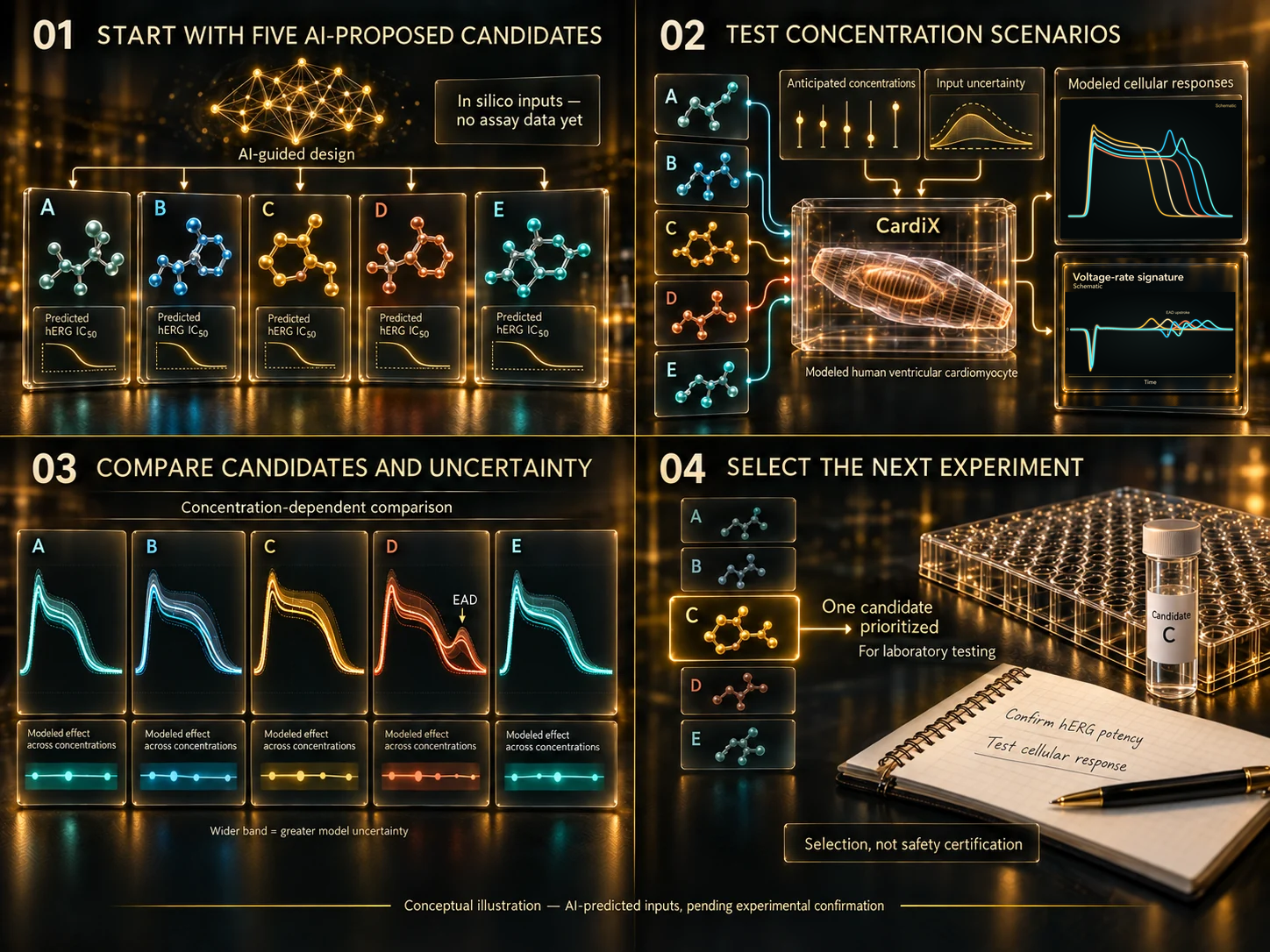
01 / START WITH THE PREDICTED INPUTS
Connect five molecular proposals to an early cardiac question.
An AI-guided analog-design workflow had produced five candidates for the client to consider. Each came with a predicted hERG IC50, providing an initial computational estimate of inhibitory potency before laboratory channel measurements were available.
The team needed to decide which candidate to investigate next. CardiX used these predicted inputs to extend the comparison from potency estimates to their possible implications for a modeled cellular response.
02 / DEFINE THE CONCENTRATION QUESTION
Examine the range that matters for the next experiment.
The client supplied an anticipated concentration range. CardiX applied the predicted hERG effects across those scenarios, allowing the team to examine how the modeled response developed as concentration changed.
This concentration-dependent view gave context to the potency estimates. A candidate’s modeled behavior could be considered across the proposed range, rather than reduced to a single predicted IC50 value.
03 / COMPARE THE CANDIDATES
Bring the alternatives into one cellular framework.
All five candidates were examined across the selected concentration scenarios. Their modeled cellular responses provided a common basis for comparing the alternatives and deciding which deserved the next laboratory experiment.
The predicted origin of the channel inputs remained explicit throughout the interpretation. This helped keep the decision focused on experimental prioritization and on the evidence that the next measurement needed to supply.
04 / RETURN TO THE LABORATORY
Choose one candidate for the next test.
The client selected one of the five candidates for laboratory testing. The practical outcome was a specific experimental choice at an early discovery stage, when channel evidence consisted of computational predictions.
The planned experiment would provide measured evidence against which to assess the initial prediction and refine subsequent modeling. That created a clear progression from AI-proposed molecules, through a cellular comparison, to a focused laboratory question.
WHAT THIS ENABLED
One focused next experiment from five computational candidates.
The concentration-dependent model comparison helped the client prioritize one of five AI-proposed candidates for the next laboratory experiment.
CardiX uses proprietary ADETERA mathematical models and scientific methods. Detailed formulations and implementation methods are not disclosed.
INTERPRETING THIS CASE
hERG potency was predicted, not measured, and the laboratory outcome is not reported here. The prioritization depends on prediction and model uncertainty; it does not establish a safe dose or clinical safety.