Home Use Cases Home X-Platforms Use Cases Contact
USE CASES | ADETERA SYSTEMS IN PRACTICE
Scientific questions. Practical research outcomes.
These selected, anonymized examples show how tailored PlateX workflows helped research teams make difficult recordings usable, compare assay responses and focus their next development decisions. They represent only a small part of ADETERA’s work; our projects and applications extend well beyond the cases shown here.
PLATEX | ANONYMIZED CASE STUDY
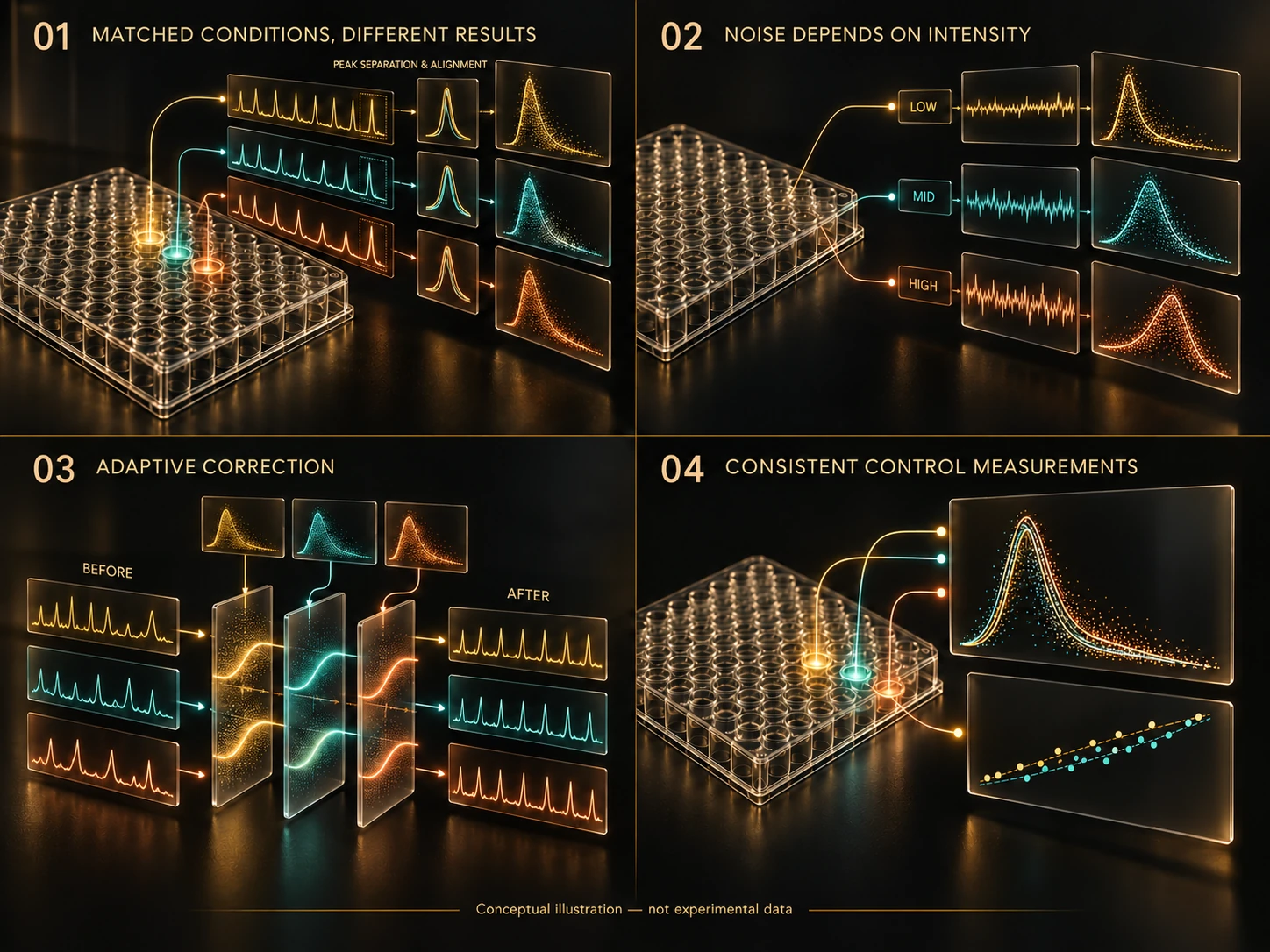
A difficult kinetic assay became usable for the next research stage, with consistent controls and stable calibration responses.
Case at a glance
Challenge Nominally matched wells produced inconsistent peak statistics after separation and alignment.
Approach Characterize the intensity-dependent noise and apply a tailored adaptive correction.
Outcome Repeat controls and calibration supported a usable measurement and analysis workflow for further investigation.
Read full case →
The illustration is a conceptual reconstruction, not experimental data.
PLATEX | ANONYMIZED CASE STUDY
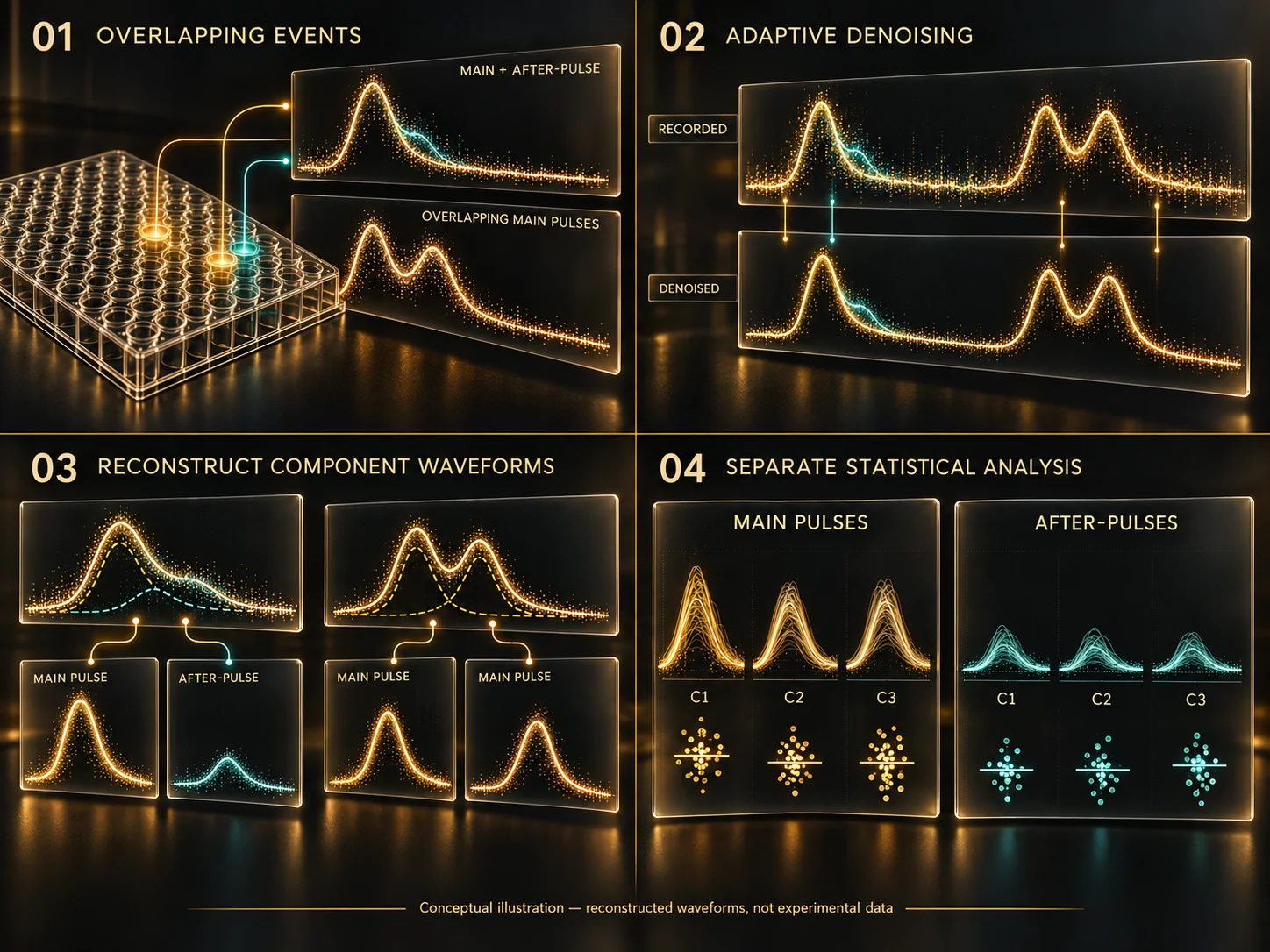
Separate waveform collections and statistics gave the client a clearer basis for examining both event populations across drug concentrations.
Case at a glance
Challenge Noise and overlapping responses obscured smaller after-pulses and produced compound peaks.
Approach Adaptive denoising, proprietary reconstruction and aligned event collections separated the analytical questions.
Outcome The client could examine main-pulse and after-pulse waveforms and statistics independently across concentrations.
Read full case →
The illustration is a conceptual reconstruction, not experimental data.
PLATEX | ANONYMIZED CASE STUDY
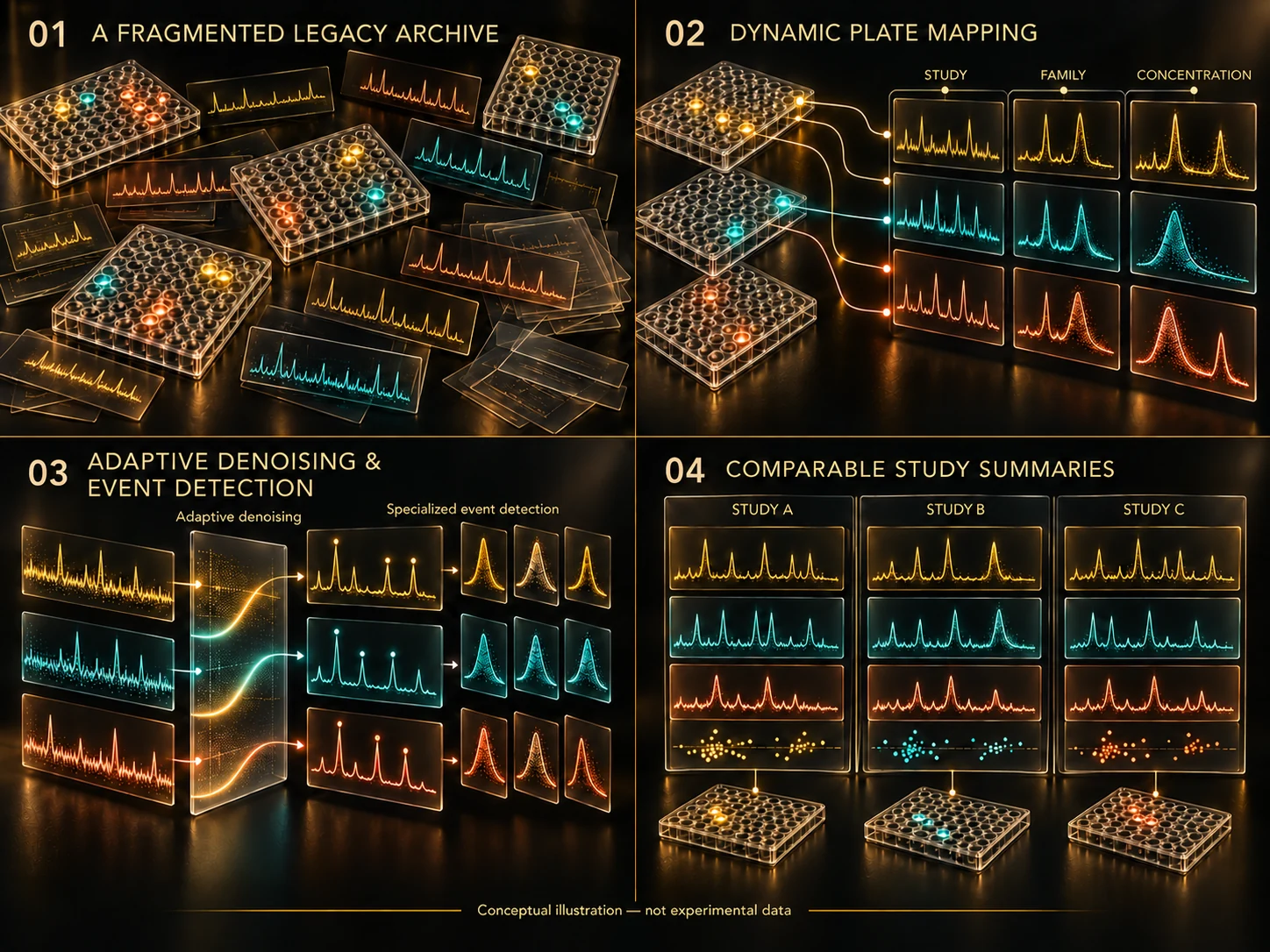
A fragmented archive became an organized analytical resource that the research team could use to compare its historical studies.
Case at a glance
Challenge Plate coordinates and well contents varied, while event assessment relied largely on manual inspection.
Approach Dynamic plate mapping, adaptive denoising and specialized event detection organized signals by the relevant experimental groupings.
Outcome The client could compare historical studies by section, family and concentration.
Read full case →
The illustration is a conceptual reconstruction, not experimental data.
PLATEX | ANONYMIZED CASE STUDY
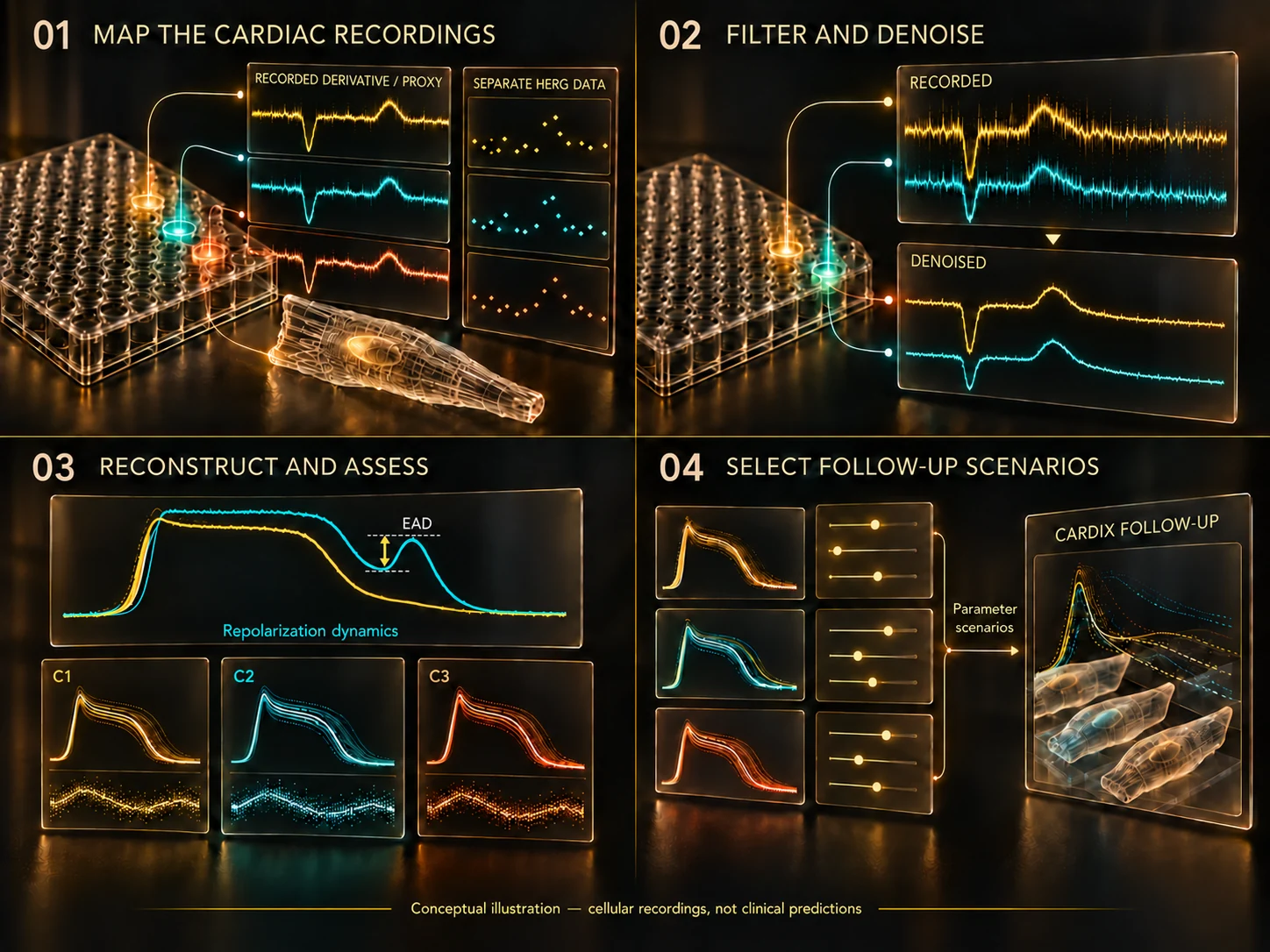
Reconstructed cellular action potentials helped the team assess concentration-related features and define further investigation.
Case at a glance
Challenge A noisy cardiomyocyte assay recorded a proxy related to membrane potential, rather than action potentials directly.
Approach Tailored denoising and model-informed reconstruction supported assessment of duration and repolarization features.
Outcome The analysis guided follow-up questions; separate hERG measurements retained their own provenance, and CardiX simulation was a possible later stage.
Read full case →
The illustration is a conceptual reconstruction, not experimental data.
PLATEX | ANONYMIZED CASE STUDY
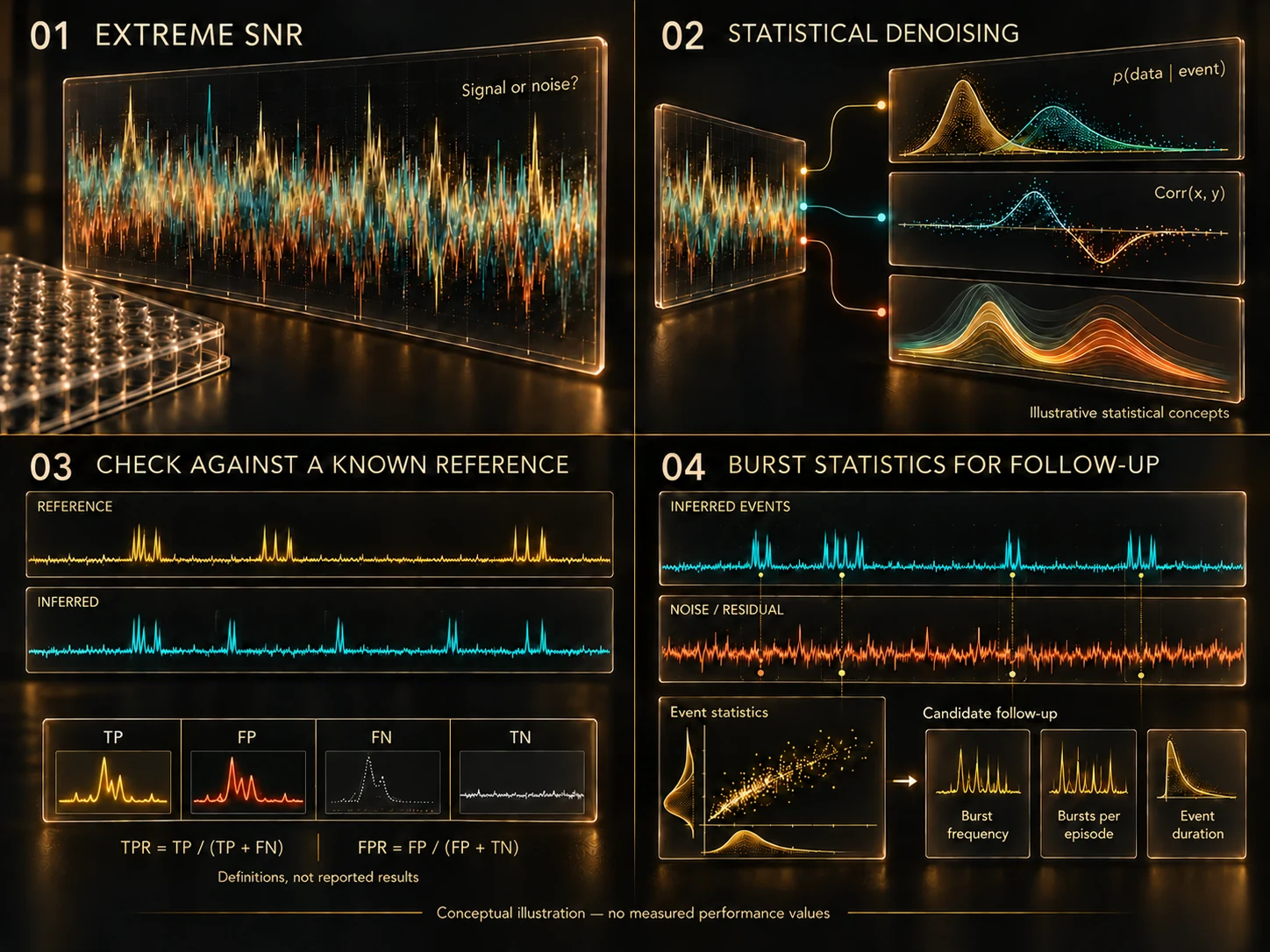
Event and burst statistics helped a research team focus drug-candidate priorities when conventional filtering distorted useful signal structure.
Case at a glance
Challenge Extreme noise prevented reliable statistical confirmation of activity suggested by other evidence.
Approach Proprietary statistical denoising was assessed on a group with known results before analysis of client recordings.
Outcome The client obtained event and burst statistics that informed drug-candidate priorities.
Read full case →
The illustration is a conceptual reconstruction, not experimental data.
These selected use cases illustrate a small part of what ADETERA can address. Each engagement is tailored to the scientific question, available data and development decision; our work is not limited to the applications shown here.