Focus development effort
Prioritize experiments around the route, operating window and particle attributes most relevant to the next decision.


CRYSTALLICX | CRYSTALLIZATION & PARTICLE ENGINEERING
Crystallization, particle engineering and API isolation — connected from phase behavior and growth regimes to size, shape, filtration and drying.
For CMC leaders, process development teams and manufacturing scientists.
THE BUSINESS CASE
A high crystallization yield is only part of a successful process. Difficult filtration, fragile needles, inconsistent flow or demanding milling can shift cost and risk downstream. CrystallicX helps development leaders evaluate these trade-offs together and focus investment on a practical material and process target.
Prioritize experiments around the route, operating window and particle attributes most relevant to the next decision.
Consider filtration, milling, micronization, flow and storage needs before committing to a crystallization strategy.
Compare yield and recovery goals with solid-form requirements and processability, using an evidence-based development plan.
CONNECTED DEVELOPMENT & MANUFACTURING CHALLENGES
CrystallicX is a tailored crystallization development system: a combination of models, methods and specialist knowledge. We study the current problem, identify the evidence needed and design theoretical or experimentally grounded improvements around the process.
Crystallization process development connects how crystals form with the properties needed in the isolated product. Supersaturation is the driving condition created when a solution holds more dissolved material than the equilibrium solubility permits at that temperature and composition. Nucleation, subsequent growth and changes to existing particles shape the population that the process must isolate.

01 / PHASE BEHAVIOR & YIELD
Some crystallizations have a straightforward operating window. Others involve complex phase behavior, competing solid forms, solvent inclusion or narrow regions in which the desired material is stable. A condition that looks attractive in isolation may be difficult to operate or reproduce.
We evaluate candidate routes and stability regions in the context of the compound, solvent system and available evidence. Cooling, antisolvent addition and solvent-removal strategies are considered together with yield targets, recovery and solid-form requirements. Where the evidence is incomplete, the next experiments are designed to resolve the uncertainty that matters most.
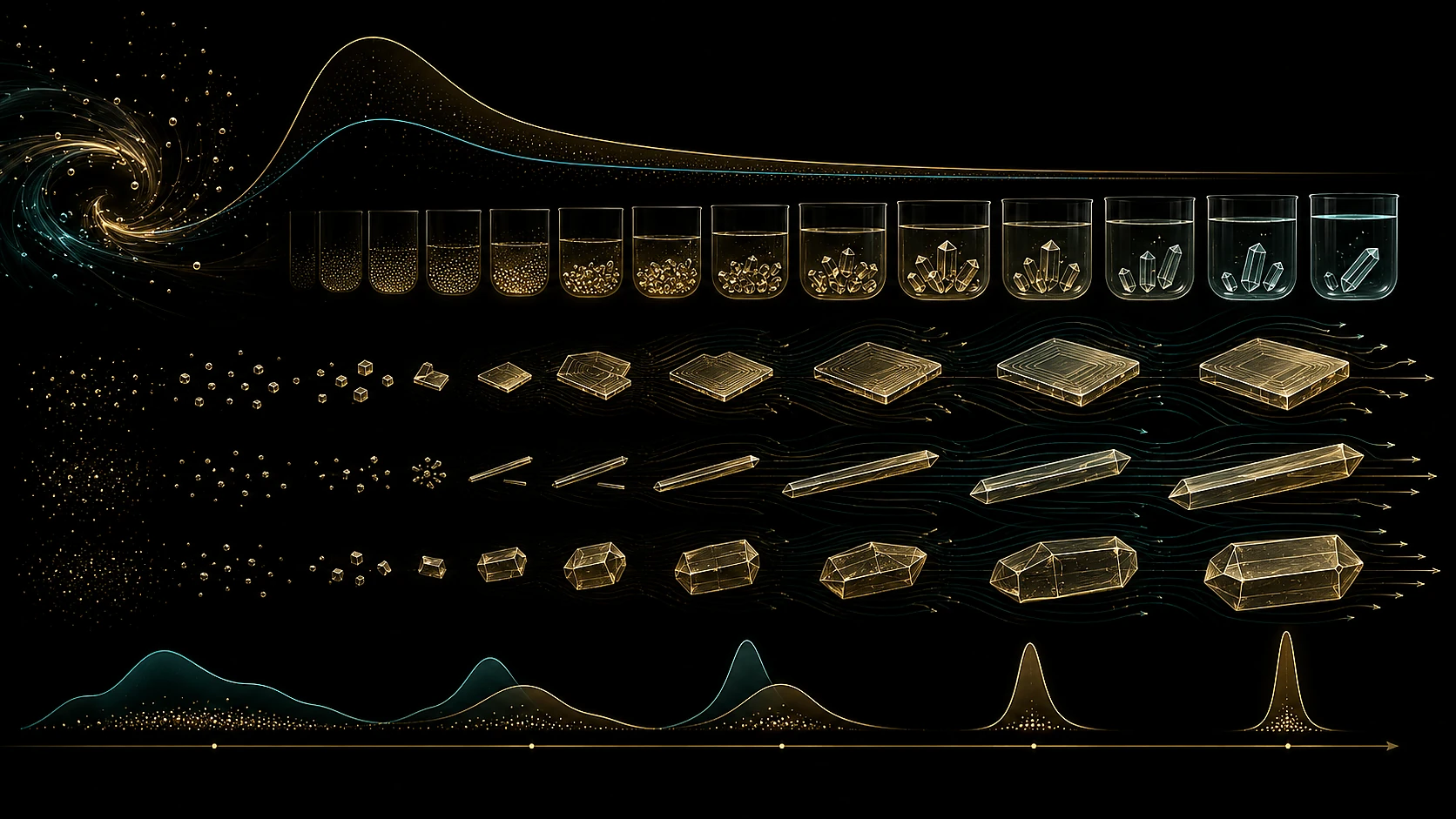
Growth regimes describe what limits the rate at which a crystal grows: transport of solute to the crystal surface, incorporation at the surface, or a combination of both. Common descriptions include diffusion or mass-transfer control, surface-integration control (also described as surface-reaction control), and mixed control. A shift in the limiting step can change how useful a mixing or temperature adjustment will be.
As temperature, composition, mixing or supersaturation change, a process can move between growth regimes. Supersaturation is the driving condition created when dissolved concentration exceeds equilibrium solubility. Different faces can respond differently, changing growth rate and habit even while the polymorph remains the same. Unrecognized transitions can therefore make morphology less predictable. We consider these kinetic regimes alongside phase behavior when assessing a process path: a growth-regime map adds information that an equilibrium phase diagram alone does not provide.
Decision supported: which route and operating region deserve development effort, and what must be confirmed before committing.

02 / PARTICLE SIZE & SHAPE
Particle-size distribution (PSD) describes the range and relative abundance of particle sizes, while crystal habit describes external shape. Particle-shape distribution describes the mix of these shapes across the population. A batch with an acceptable average size may still contain fines or long needles that behave differently during filtration and handling. CrystallicX connects these observations of the particle population to millability, suitability for micronization, flowability and the storage or preformulation requirements of the project.
Crystal habit engineering may, for example, investigate a shift from long needles toward shorter rod-like habits while retaining the intended polymorph. Changes to supersaturation management are assessed against these particle targets and solid-form requirements. This is a material-specific development objective, verified with solid-form and particle evidence. The aim is to improve the balance of processability and material performance, rather than optimize size alone.
Decision supported: which particle attributes are worth targeting and how the proposed changes should be evaluated downstream.

03 / STRATEGY & EXPERIMENTAL EVIDENCE
We investigate the combination of crystallization route, seeding point and seed attributes, addition or cooling profiles, and tailored temperature or dissolution–growth cycles. Seed form, loading and size distribution define the starting crystal population and the evidence needed to interpret its subsequent growth. Solvates and channel-solvent inclusion can be incorporated into the problem definition where they affect the desired material.
Projects can use process analytical technology (PAT) where available, or be built around planned sampling and offline measurements. The resulting system can range from a focused theoretical study to experimentally supported method optimization or an automated workflow. The measurement strategy and the development method are designed together.
Decision supported: a practical strategy, evidence plan and operating conditions to evaluate in the next development stage.

04 / MANUFACTURING ISOLATION
At manufacturing scale, these considerations also matter when isolating the product after a reaction. Active pharmaceutical ingredient (API) isolation turns the crystallization slurry into recovered dry material. Filtration is the solid–liquid separation step that forms a cake; particle size and shape influence filterability. Cake washing helps remove retained mother liquor. Deliquoring removes liquid from the cake before drying reduces the remaining solvent. These operations must be assessed together to preserve the particle and solid-form attributes established upstream.
Particle size, shape and fines influence cake formation, permeability and the retention of liquid. Washing and drying can introduce further changes: dissolution or reprecipitation, agglomeration, crystal breakage and residual-solvent concerns. A desirable slurry can therefore become a difficult filter cake or an inconsistent dry product if these stages are considered separately.
CrystallicX brings isolation constraints into the crystallization development question. We relate the proposed particle target and route to filtration, cake washing, deliquoring and drying evidence, and identify the measurements needed to examine behavior at the intended scale.
Decision supported: an integrated development strategy for material recovery, cake handling and the quality of the isolated product.
HOW WE WORK
We define the material and business decision first, then determine the appropriate combination of modeling, experiments and delivery.
ADETERA SYSTEMS & INTELLECTUAL PROPERTY
CrystallicX combines proprietary ADETERA mathematical models, methods and scientific know-how. We commercialize this capability through tailored systems and development engagements. Detailed model formulations and implementation methods are ADETERA intellectual property and are not disclosed on this public website.
Clients receive the agreed outputs, interpretation and evidence relevant to their decision. The delivery format is selected around the team’s workflow and infrastructure.
SOLVENT STRATEGY TO CRYSTALLIZATION
CrystallicX can start from an existing crystallization problem or continue the solvent-system work developed with SolveX. Solvent and mixture choices, route constraints and preliminary yield considerations then feed into crystallization strategy, solid-form evidence and particle engineering.
Explore SolveX solvent and process selectionQUESTIONS ABOUT CRYSTALLICX
Yes. An engagement can begin with theoretical assessment and an evidence-gap review, followed by a focused experimental plan. Predictions and proposed improvements are assessed against the material and process data as they become available.
No. The workflow can use PAT when appropriate or rely on planned sampling, offline measurements and existing laboratory tools. The scope depends on the decision, available infrastructure and quality of evidence needed.
That can be a study objective: for example, investigating shorter rods instead of long needles while preserving the intended solid form. Feasibility and retention of that form must be confirmed for the specific compound and conditions.
PSD describes the spread of particle sizes; crystal habit describes the external shape. A single average size can hide a fine-particle fraction or a broad mix of needles and compact particles. CrystallicX connects these observations to filtration, flow and milling objectives, so the material target describes the population and the downstream behavior that the team needs to investigate.
A seeding study considers the seed solid form, size distribution, loading and addition point alongside the cooling or antisolvent profile. The evidence should show how the seed population develops and whether additional particles or unwanted forms appear. CrystallicX helps frame this study around the intended particle target and the measurements available in the laboratory.
API isolation turns a crystal suspension into recovered dry material. Filtration forms the cake; washing displaces retained mother liquor; deliquoring and drying remove liquid from the solids. These steps can change particle attributes and recovery. An integrated study examines cake behavior, material lost to liquid streams and the isolated product, so a crystallization improvement can be assessed through the complete recovery sequence.
Changes in mixing, temperature or composition can alter the balance between transport to the crystal and incorporation at its surface. Different crystal faces can respond at different rates. Examining this kinetic context alongside phase behavior helps formulate experiments to investigate variable habit, distinguish plausible explanations and assess a more reproducible operating path for the specific material.
The agreed deliverable may be a development study, optimized method, standalone system or automated workflow. We define the expected outputs, evidence and operational fit at the start of the engagement.
START A SCIENTIFIC CONVERSATION
Tell us about the material, current process bottleneck and the yield or particle attributes your next development stage requires.