

Focus the experiment, evidence or process choice that can change the development plan.
BOSTON-BASED SCIENTIFIC COMPUTING
ADETERA turns difficult scientific questions into development decisions.
Tailored scientific systems for microplate analytics, cardiac safety modeling, solvent selection, crystallization and API isolation.
Protect assay investment, focus safety follow-up and choose workable development routes. We connect specialist science with the decisions your R&D and CMC teams need to make.


ADVANCED SCIENCE. REAL IMPACT.
Physics-Based Modeling
Scientific Data Intelligence
In Silico R&D
Configured to your data and workflow: standalone, automated or integrated delivery.
Interpret results with their assumptions, uncertainty and experimental context.
X-PLATFORM PORTFOLIO
Four scientific platforms. Systems built around your decision.
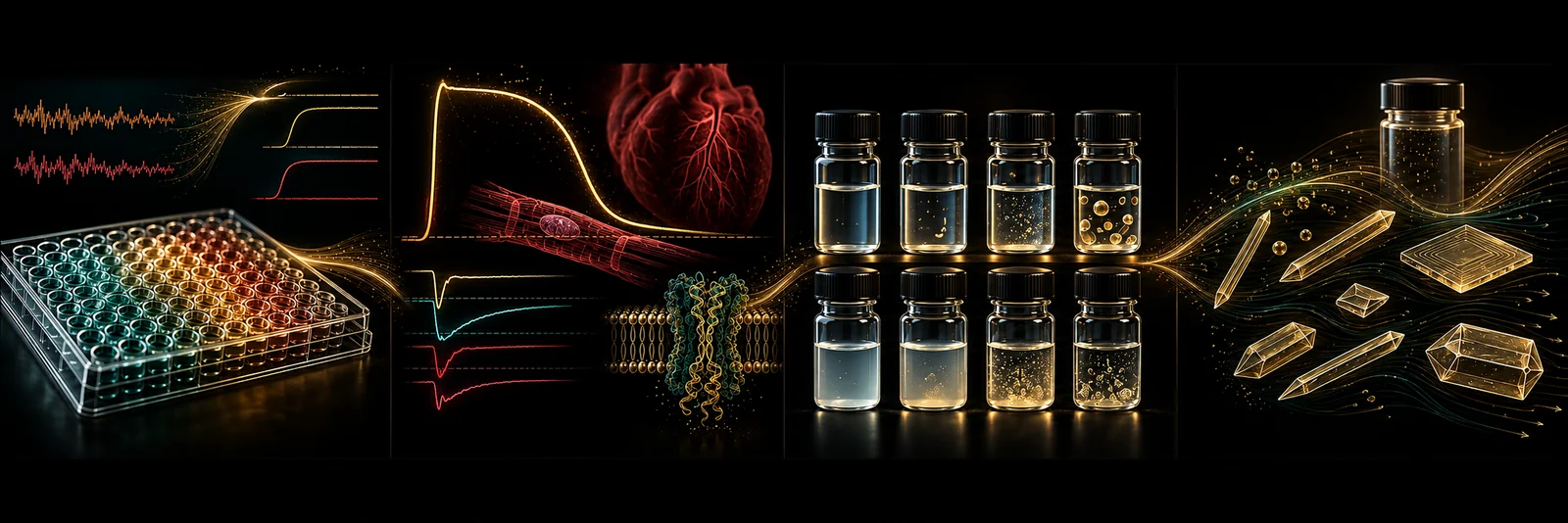
Four specialist capabilities support screening, preclinical safety and pharmaceutical process development. Each is delivered as a tailored system for R&D or chemistry, manufacturing and controls (CMC) teams, connecting scientific evidence with the next experiment, candidate assessment or process decision.
01
PlateX
Protect assay investment by connecting plate workflows with interpretable results and focused confirmation.
Microplate and plate-reader data analysis, automated plate workflows, kinetic events and advanced statistical investigation of extremely weak responses.
Plate workflows and signal rescue ↘ 02CardiX
Resolve cardiac uncertainty earlier and direct follow-up toward the exposure and combination questions that matter.
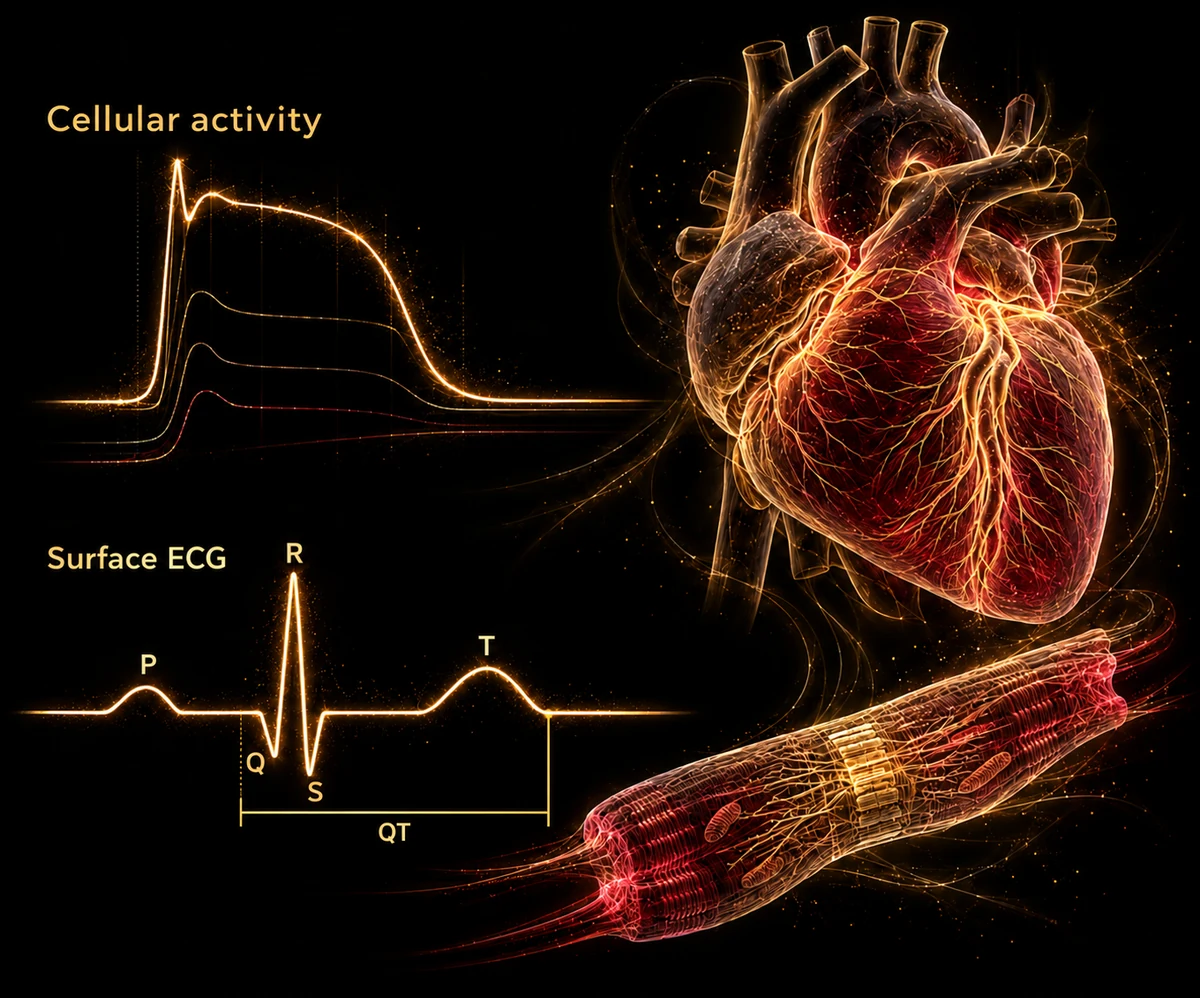
In silico cardiac safety modeling combines multichannel evidence, tailored virtual cell families and variability analysis to focus further investigation.
Cardiac liability modeling ↘ 03SolveX
Focus laboratory effort on solvent strategies that fit the molecule, the process and the recovery objective.
Pharmaceutical solvent and mixture selection, solvent exchange, antisolvent routes, solvate concerns and preliminary recovery evidence.
Solvent and process strategy ↘ 04CrystallicX
Develop particle and process targets that carry batch value through crystallization, isolation and drying.
Crystallization process development and particle engineering connect phase behavior, size and shape with API filtration, cake washing and drying.
Crystallization and API isolation ↘USE CASES | SELECTED ANONYMIZED PLATEX STORIES
See the science behind the next decision.
See how research teams made difficult assays usable, compared historical studies and focused candidate follow-up with tailored PlateX analysis.
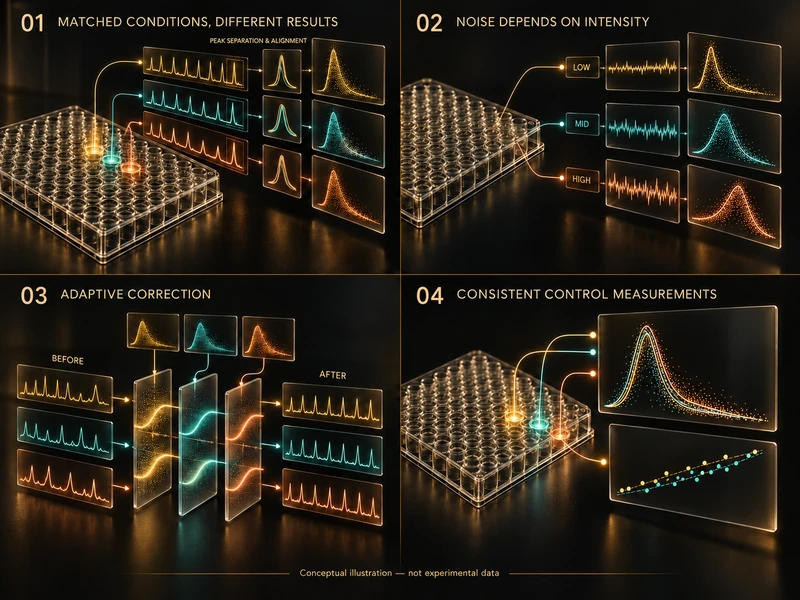 Restoring confidence in multi-peak assay analysis. Conceptual illustration
PLATEX | X-PLATFORM
Keep valuable assays moving toward a decision.
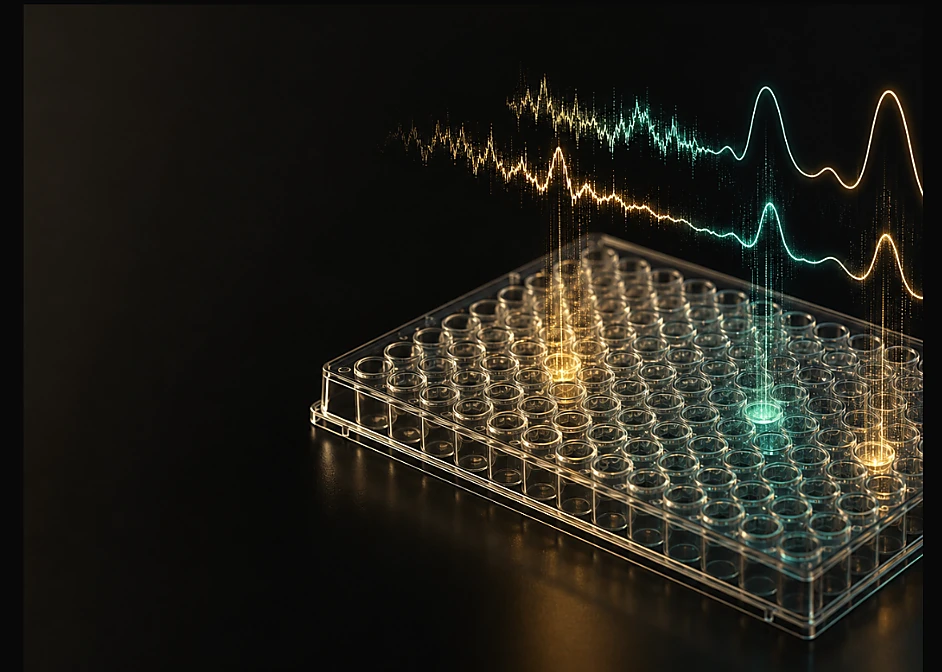
PlateX connects plate mapping, data collection and automation with the analysis your assay needs: conventional signal processing, kinetic event analytics or advanced statistical investigation of extremely weak responses.
Plate context and event analytics
From well mapping and collection to interpretable results- Plate mapping, data collection and automated workflows
- Combined filtering, statistical sub-signal and peak analysis
- Event detection, kinetics, dose-response and well / plate QC
Advanced signal rescue
For extremely weak responses with signal-like noise- Specialized statistical denoising and response assessment
- Review of false-negative and false-positive possibilities
WHY IT MATTERS
Connected plate workflows • Fewer analysis handoffs • Interpretable results • Focused confirmation
PLATEX | SIGNAL RESCUE
Investigate the information hidden in difficult readouts.
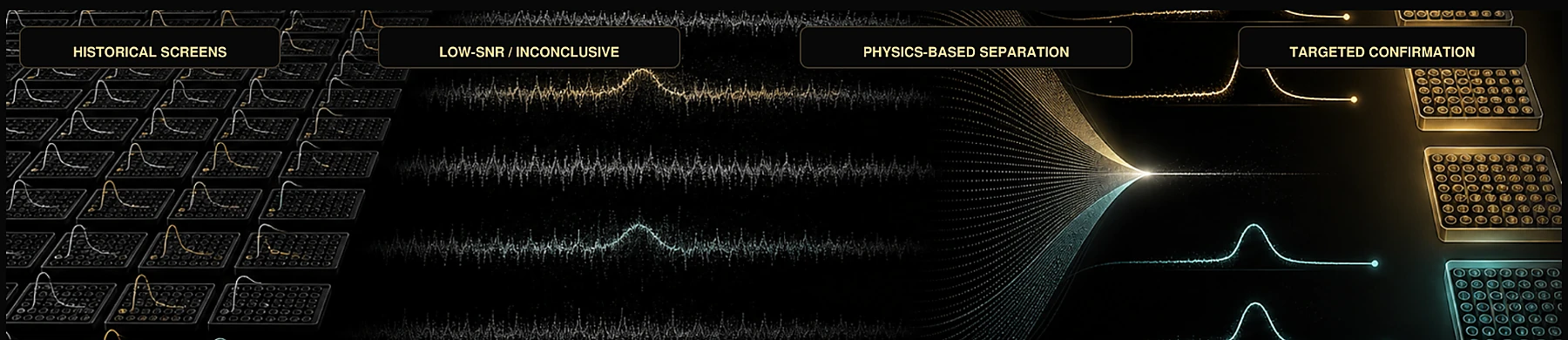
A uniquely informative assay may produce a response that is extremely weak and resembles the noise. PlateX brings specialized statistical investigation to this problem. ADETERA has demonstrated the approach on example datasets; client studies assess representative data, controls and the evidence needed for confirmation.
Assess whether the data support a response or leave the scientific question unresolved.
Re-evaluate historical data and identify the cases worth further experimental attention.
Examine supported patterns and false-call possibilities to focus the next experiment.
BUSINESS VALUE
Protect assay investment • Review missed-response risk • Prioritize confirmation
CARDIX | X-PLATFORM
Bring cardiac uncertainty into the development decision.
CardiX connects multichannel evidence with tailored virtual cell families, parameter variability and combination scenarios. The aim is to identify consistent findings, sensitive boundaries and the follow-up evidence worth obtaining next.
MULTICHANNEL EVIDENCE
Available channel profiles, potency variability, exposure scenarios and laboratory cell context.
TAILORED VIRTUAL CELL FAMILIES
Explore interacting channel effects across cell behavior configured around the study’s reference evidence.
VARIABILITY AND STABILITY
Compare plausible inputs and exposure ranges to identify consistent behavior and sensitive boundaries.
CO-MEDICATION SCENARIOS
Assess combined channel effects at specified exposures to prioritize confirmation and candidate mitigation studies.
ATTRACTORS, TRAJECTORIES
& STABILITY PATTERNS
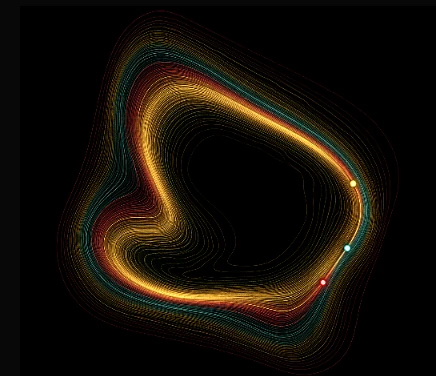 Classical metrics, attractor, trajectory and correlation analyses provide complementary views of the response and its sensitivity to uncertain inputs.
BUSINESS VALUE
Earlier liability questions • Focused confirmation • Co-medication evidence planning
SOLVEX | X-PLATFORM
Choose a solvent strategy your process can use.
SolveX compares single- and multi-solvent systems in the context of the whole route: dissolution, distillation or exchange, antisolvent addition and recovery. Solvate concerns and preliminary crystallization evidence inform the experimental priorities.
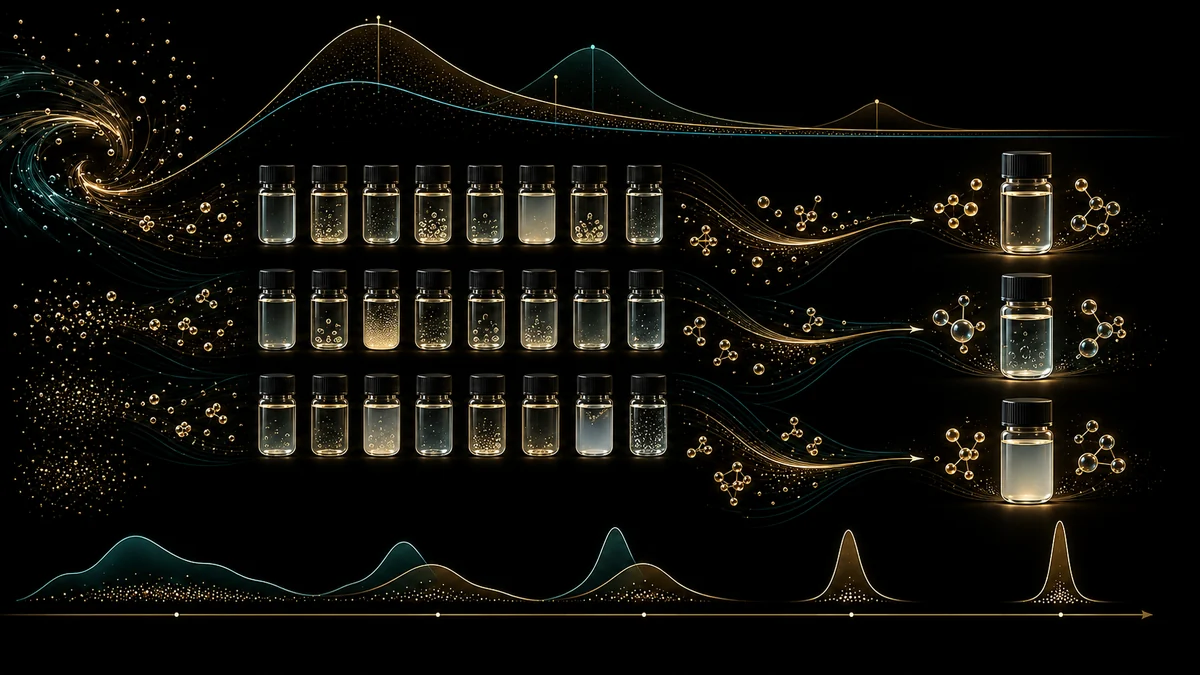
Compare connected systems
Assess individual solvents and multi-solvent options against the molecule, process sequence and experimental evidence.
Plan changes in composition
Investigate distillation, solvent exchange, antisolvent routes and combinations that fit the next process step.
Balance interactions and recovery
Weigh dissolution needs against strong solvent interactions, solvate concerns, carryover and yield objectives.
Build the crystallization case
Use preliminary crystallization and recovery evidence to focus verification, then continue into CrystallicX when needed.
Explore CrystallicX ↘CONNECTED DEVELOPMENT WORKFLOW
From the solvent system to the crystals you need.
Relevant solvent-system evidence carries into CrystallicX for crystallization strategy, particle engineering and the filtration, washing and drying needs of the isolated product.
Continue with CrystallicX ↘- SolveXSolvent & process strategy
- CrystallicXCrystallization & particles
- CrystallicXIsolation & processability
BUSINESS VALUE
Focused laboratory effort • Earlier process trade-offs • A clearer recovery plan
CRYSTALLICX | X-PLATFORM
Engineer crystals your process can handle.
CrystallicX connects phase behavior and growth kinetics with particle size, shape and processability. Cooling, antisolvent and solvent-removal routes are evaluated against yield, solid-form and downstream handling objectives.
The development question extends through active pharmaceutical ingredient (API) isolation: filtration, cake formation, washing and drying. CrystallicX can begin with an existing process problem or continue the solvent-strategy work developed with SolveX.
Explore CrystallicX: crystallization, particles and API isolation
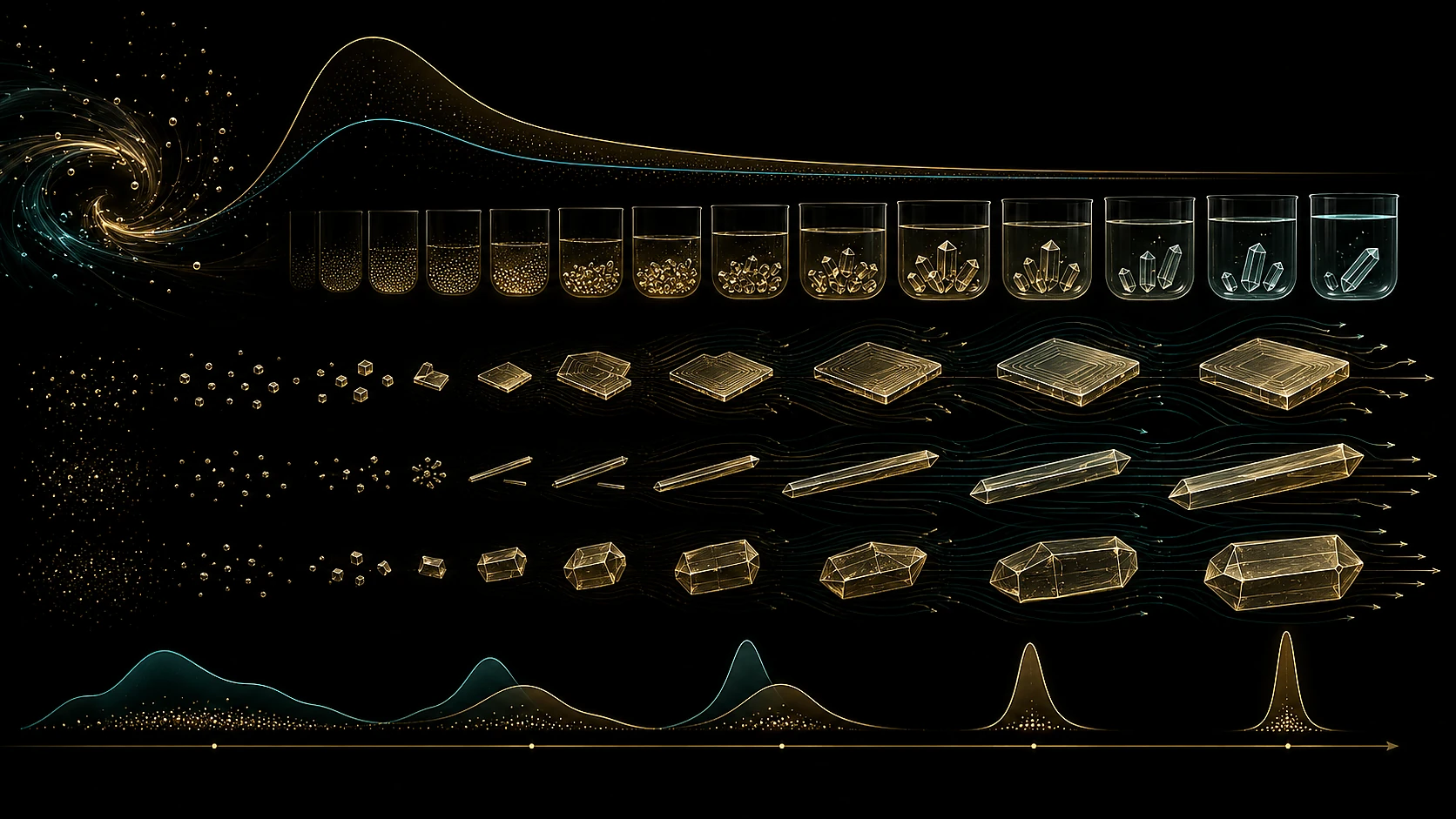
Understand phase and growth regimes
Consider phase behavior alongside transport, surface-growth and mixed kinetic regimes that can change crystal habit.
Target usable particle attributes
Connect size, shape and solid-form objectives with filtration, milling, flow, storage and preformulation needs.
Build the process strategy
Examine routes, seeding and process profiles using appropriate measurements, with or without in-process analytical tools.
Carry value through isolation
Relate particle targets to cake formation, permeability, washing and drying while preserving the intended material attributes.
BUSINESS VALUE
Practical particle targets • Visible yield trade-offs • Connected isolation strategy
SCIENTIFIC APPROACH
Decision-first. Tailored. Scientifically grounded.
The development decision defines the scope. We select and configure the scientific capability around the available data, the evidence needed and how your team will use the result. Delivery can be standalone, automated or integrated.
Define the decision
Clarify what experiment, asset or development-path decision the output must change. This keeps the work anchored to practical value.
Represent the science
Use mechanistic relationships, physical constraints and traceable assumptions so the method remains understandable and scientifically defensible.
Configure the system
Match the analytical workflow, interfaces and outputs to the client’s data and operating environment.
Deliver usable evidence
Make confidence, uncertainty and next-step implications explicit, so teams can act without losing sight of what the evidence can and cannot support.
PHYSICS-BASED MODELING
IN VITRO DATA INTELLIGENCE
IN SILICO R&D
SCIENTIFIC DECISION SUPPORT

ABOUT ADETERA
Scientific computing for pharmaceutical development.
ADETERA is a Boston-based scientific-computing company building tailored systems for screening, cardiac safety and pharmaceutical process development.
ADETERA combines scientific modeling, data intelligence and in silico R&D with the client’s experimental evidence. X-Platform engagements can deliver a focused development study, a standalone system, an optimized method or an automated capability integrated into an existing workflow.
The mathematical models, specialized methods and implementation know-how developed by ADETERA are proprietary intellectual property. Their detailed formulations and implementation are not published on this site. Clients receive the agreed outputs, interpretation and evidence relevant to their decision.
BOSTON, MASSACHUSETTS
Bring us the difficult scientific question.
For X-Platform discussions, pilot opportunities and scientific collaborations. If your data are complex, noisy or hard to interpret, that is usually the right starting point for a conversation.
contact@adetera.com↗Send us a message
Tell us about your scientific question. We will use your email address to reply.