

PLATEX | ANONYMIZED CASE STUDY
Extreme SNR — Recovering Ion-Channel Burst Statistics
Turn highly uncertain ion-channel recordings into event-level evidence that helps a research team focus its drug-candidate priorities.
THE SCIENTIFIC QUESTION
In this client assay, a very low signal-to-noise ratio (SNR) made weak-signal event detection difficult: individual ion-channel events and burst patterns were obscured by noise. Other evidence suggested activity, but the recordings could not reliably confirm it statistically. PlateX used proprietary statistical denoising, first assessed against known results, to support event separation and burst analysis.
- The challenge
- Ion-channel bursts obscured by extremely low signal-to-noise conditions
- The intervention
- Statistical denoising assessed against known results
- The outcome
- Event and burst statistics that informed candidate priorities
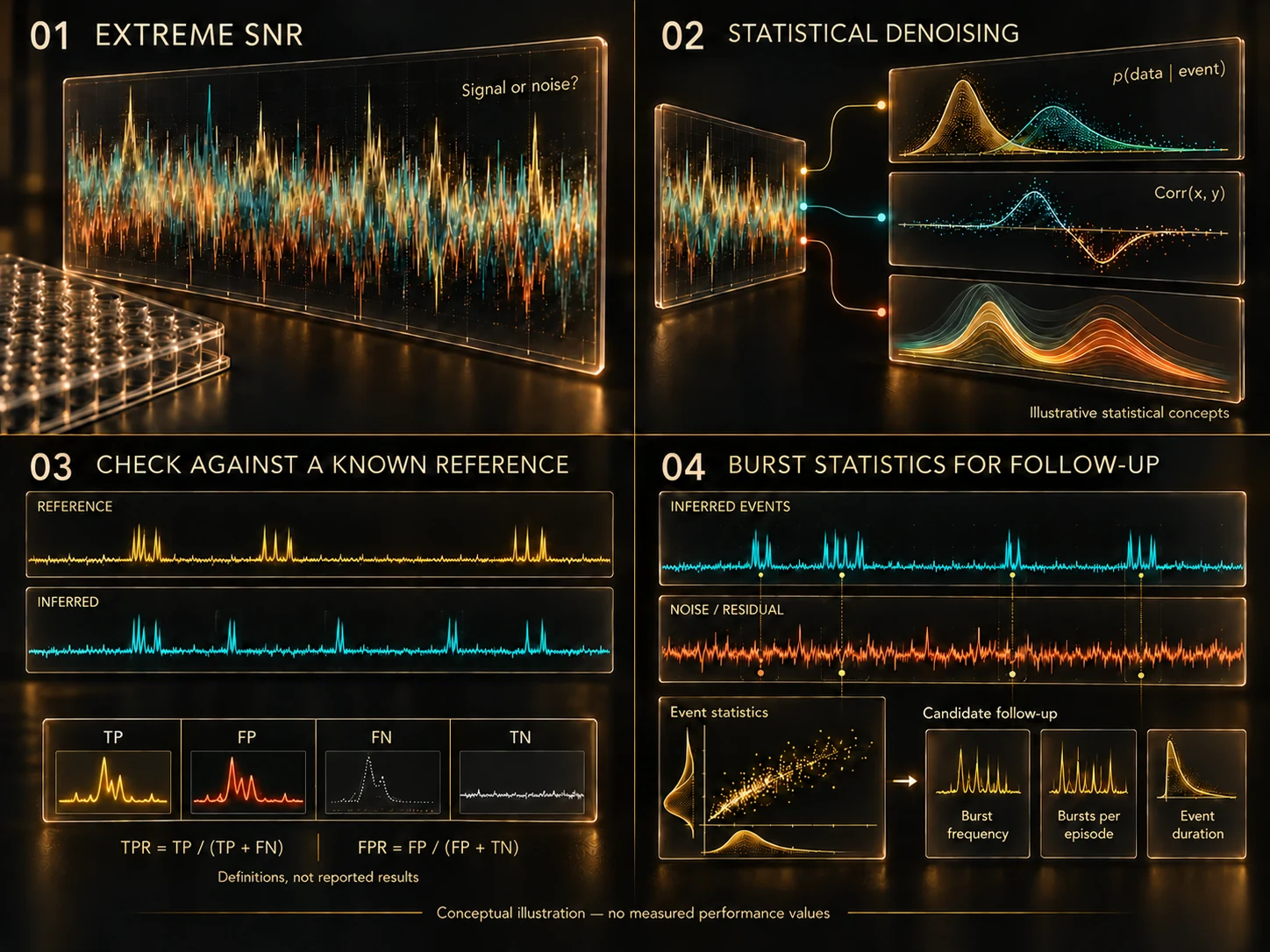
01 / ACTIVITY OBSCURED BY NOISE
When expected activity cannot be resolved reliably
Evidence from other sources suggested that channel activity was present. Within the assay recordings, however, noise made individual events and burst patterns difficult to distinguish. Conventional filters distorted useful signal structure, leaving the team without a dependable basis for the required statistics.
The development question was practical: could these recordings yield useful evidence for comparing candidates, despite the ambiguity in the raw traces?
02 / STATISTICAL DENOISING
Examine the information carried by the noisy signal
ADETERA applied proprietary statistical denoising to the recorded data. The focus was the information needed for event and burst analysis, including the risk of missing genuine activity or treating noise as an event.
Noise reduction and detection were considered together. A cleaner-looking trace alone cannot establish whether a detected burst is real, so the workflow needed an assessment against known results before its application to unresolved client recordings.
03 / ASSESSMENT AGAINST KNOWN RESULTS
Benchmark the approach before separating client events
The approach was first tested on a group with known results. In that assessment, the statistics improved, providing a reference for the subsequent client analysis.
The workflow was then applied to the client recordings to separate candidate events and derive burst-related statistics. These client results remained inferred from the available measurements; reference-group performance and certainty about individual client events were distinct questions.
04 / DRUG-CANDIDATE FOLLOW-UP
Use burst evidence to focus candidate priorities
The client obtained event and burst statistics that helped guide drug-candidate priorities. Previously difficult recordings could contribute to the development discussion through an analysis informed by the known-result assessment.
WHAT THIS ENABLED
Usable burst statistics to guide drug-candidate follow-up.
The outcome was a more useful basis for deciding which candidates warranted attention. Interpreting those statistics still depended on the available measurements and the evidence supporting event detection.