Skip to content

ABOUT ADETERA

Scientific computing for the next development decision.

ADETERA is a Boston-based scientific-computing company building tailored systems for pharmaceutical research and development. We connect specialist modeling, data analysis and experimental evidence with the decisions teams need to make.

ADETERA LLC · Boston, Massachusetts, United States

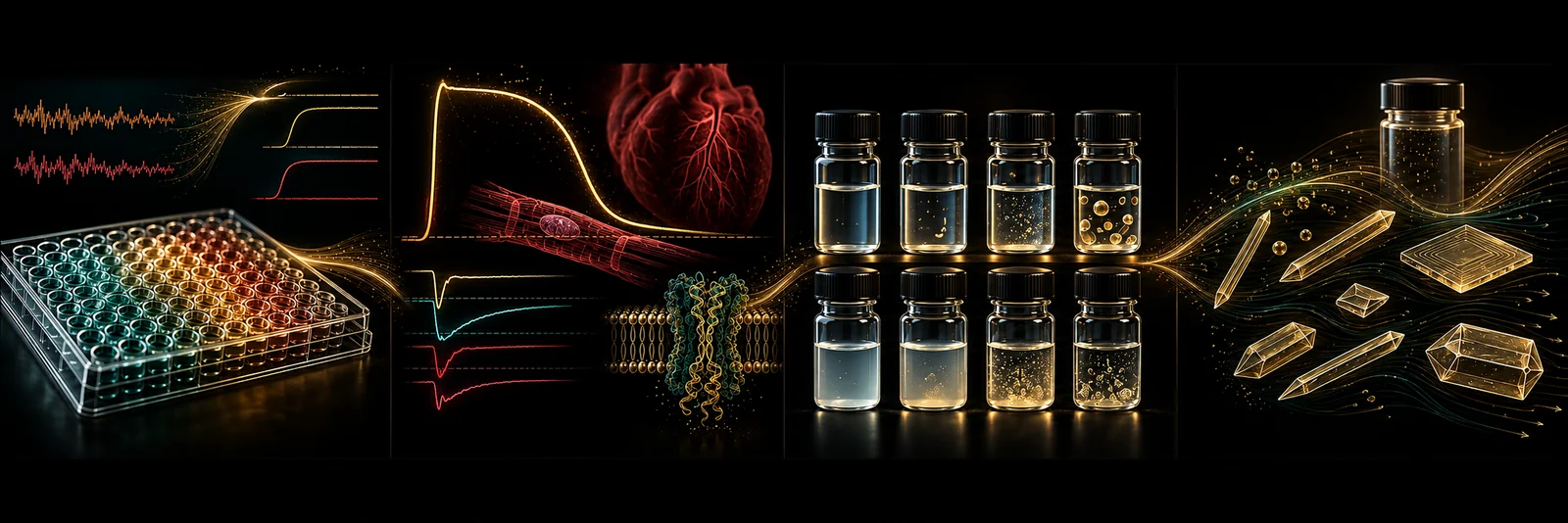
The four ADETERA scientific domains: plate analytics, cardiac electrophysiology, solvent selection and crystallization.
Conceptual illustrations of the four ADETERA X-Platforms. They do not represent experimental results.

SCIENCE WITH A DEVELOPMENT PURPOSE

Make the next question more precise.

A difficult dataset or an uncertain process choice can leave several plausible paths open. The useful result is an analysis that helps a team decide what deserves another experiment, which assumptions need testing, or how an analytical workflow should change.

We work across screening, nonclinical cardiac assessment and chemistry, manufacturing and controls (CMC). For scientists, the focus is the measurement, model and interpretation. For R&D and development leaders, it is the evidence needed to set priorities and define a practical next step. Each engagement starts with that decision and the data available to support it.

FOUR SPECIALIST CAPABILITIES

A connected portfolio, tailored to the question.

PlateX, CardiX, SolveX and CrystallicX address different scientific problems. Their role in a project depends on the experimental context, the available inputs and how the result will be used.

PlateX

Screening, assay development and data-analysis teams

PlateX connects plate mapping and data collection with kinetic analysis, event detection and interpretation. Work can range from conventional baseline and noise correction to difficult low-signal recordings and retrospective screening-data reanalysis. The decision is which responses can support comparison, which require confirmation, and how to make analysis repeatable within the assay workflow.

Explore PlateX plate analytics →

CardiX

Discovery, pharmacology and nonclinical safety teams

CardiX connects available ion-channel potency data with concentration-dependent cellular modeling. Multichannel effects, alternative cardiac-cell families and combination scenarios help frame mechanistic questions and focus follow-up. The interpretation depends on the input evidence and model assumptions; cellular action-potential changes remain distinct from clinical ECG measurements and patient outcomes.

Explore CardiX cardiac modeling →

SolveX

Process chemistry and CMC development teams

SolveX supports solvent and mixture selection in the context of the intended process. Compatibility screening is considered alongside experimental solubility, solvent exchange, antisolvent routes, recovery and solid-form concerns. A useful shortlist makes the composition and comparison basis clear, so laboratory work can focus on systems relevant to the next development step.

Explore SolveX solvent development →

CrystallicX

Crystallization, particle engineering and API isolation teams

CrystallicX connects crystallization conditions with crystal habit, particle-size distribution and downstream isolation. Cooling or addition profiles, seeding, growth regimes and experimental observations inform the study; filtration, cake washing, deliquoring and drying keep the final recovery sequence in view. SolveX can provide the starting solvent-system shortlist for this independent crystallization capability.

Explore CrystallicX crystallization →

FROM QUESTION TO USABLE SYSTEM

Define the decision, then shape the work.

The scope is agreed around the scientific problem, the available evidence and the team’s operating environment. A focused analysis and a repeatable system can require different inputs, interfaces and acceptance criteria.

Establish the question and context

Identify the comparison or decision, review the data and experimental conditions, and make the expected outputs explicit. Assay conditions, channel-data provenance or process constraints determine which interpretations are useful.

Connect analysis with evidence

Develop the agreed analysis or modeling workflow around that context. Compare relevant conditions, examine uncertainty and distinguish measured observations from modeled or reconstructed results. The interpretation should make the remaining evidence needs visible.

Deliver for the team’s workflow

Delivery can take the form of a standalone system, an optimized method, an automated workflow or integration into an existing environment. Interfaces, outputs and acceptance criteria are defined for the project, so the team knows what it receives and how it will use it.

ADETERA’s mathematical models, methods and implementation know-how are proprietary. Public materials explain the scientific question, the role of the system and the interpretation of the result. Clients receive the agreed outputs and evidence within the scope of their engagement; proprietary formulations and implementation methods are not disclosed on this website.

EXAMINE THE EVIDENCE

See the question, the approach and its limits.

Our selected anonymized PlateX and CardiX cases show how difficult recordings, assay variability, multichannel effects and candidate-prioritization questions have been approached. These stories illustrate a small part of what ADETERA can address. Their artwork is conceptual, and each narrative distinguishes the available input from the analysis and subsequent decision.

The source-linked CardiX Validation Report presents modeled results alongside published observations across 88 compounds and 98 study runs. It retains full, partial and unmatched qualitative comparisons, the original endpoint labels and compound-level context. Qualitative effect agreement is not clinical predictive accuracy; the detailed report is the place to examine what was compared and where the evidence differs.

START WITH YOUR SCIENTIFIC QUESTION

What decision does your team need to make?

Tell us the question, the data you have and the next development step. Contact ADETERA in Boston, Massachusetts at contact@adetera.com or use the website contact form.