Investigate missed-hit potential
Review weak or ambiguous responses for activity that may warrant targeted confirmation, while assessing the possibility of false detections.


NORAX | NOISE REMOVAL ANALYZER
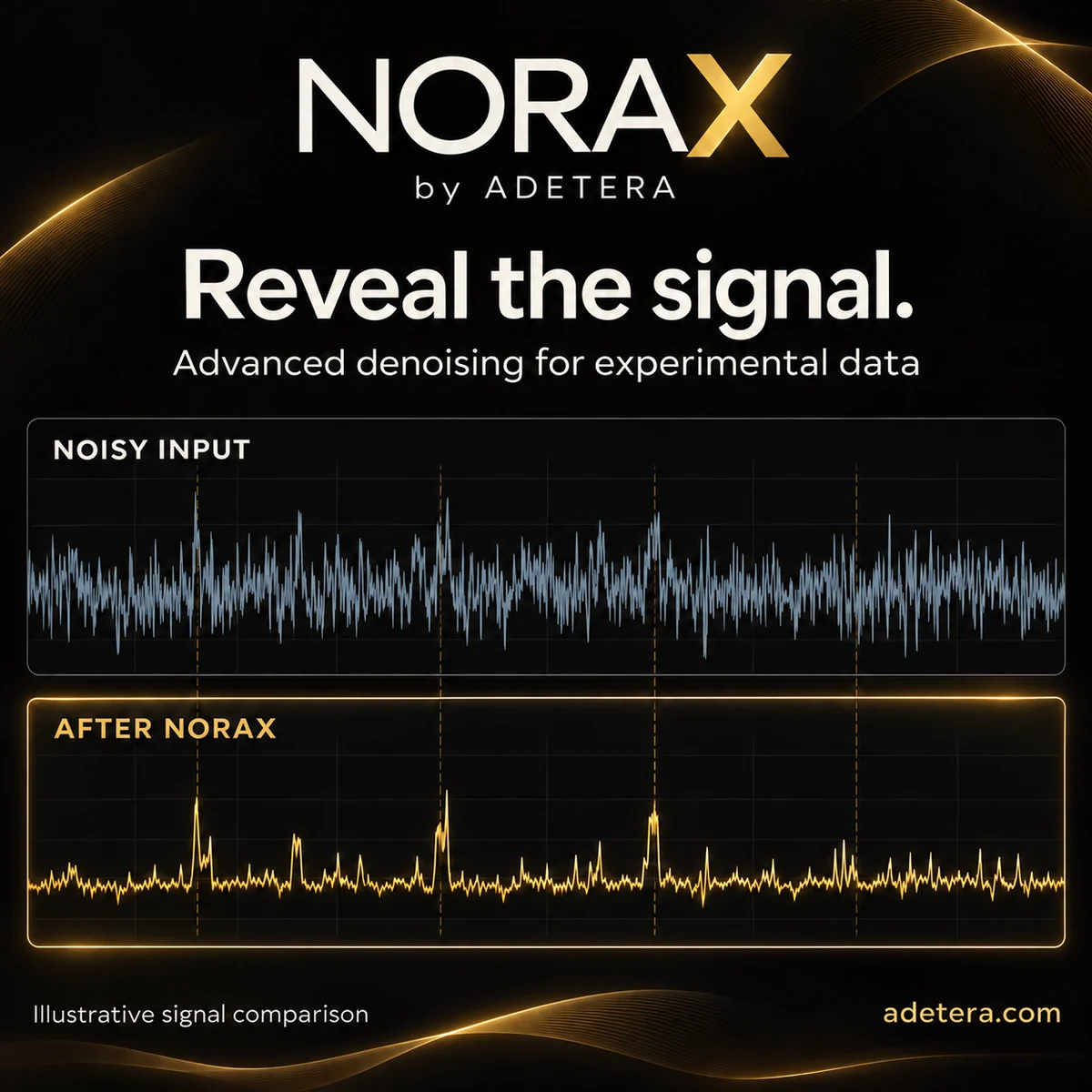
Weak responses can be overlooked when noise obscures the evidence. NORAX helps screening and R&D teams revisit difficult recordings, investigate potentially missed activity and extract more value from experiments already performed.
Advanced denoising for extremely low signal-to-noise ratios (SNR), tailored to the recorded signals, available reference data and event-level questions that matter to the study.
THE BUSINESS CASE
For screening directors and assay-development leads, an unresolved readout can mean a potential hit receives no further attention or an experiment is repeated before the existing data have been fully examined. NORAX supports a more informed choice: reassess the recording, identify what evidence it can provide and focus confirmation work on the questions that could change a decision.
Review weak or ambiguous responses for activity that may warrant targeted confirmation, while assessing the possibility of false detections.
Bring archived recordings into a focused reanalysis before deciding whether new measurements are needed.
Give scientists and project leaders an account of supported features, remaining uncertainty and the next evidence needed.
01 | EXTREMELY LOW SIGNAL-TO-NOISE
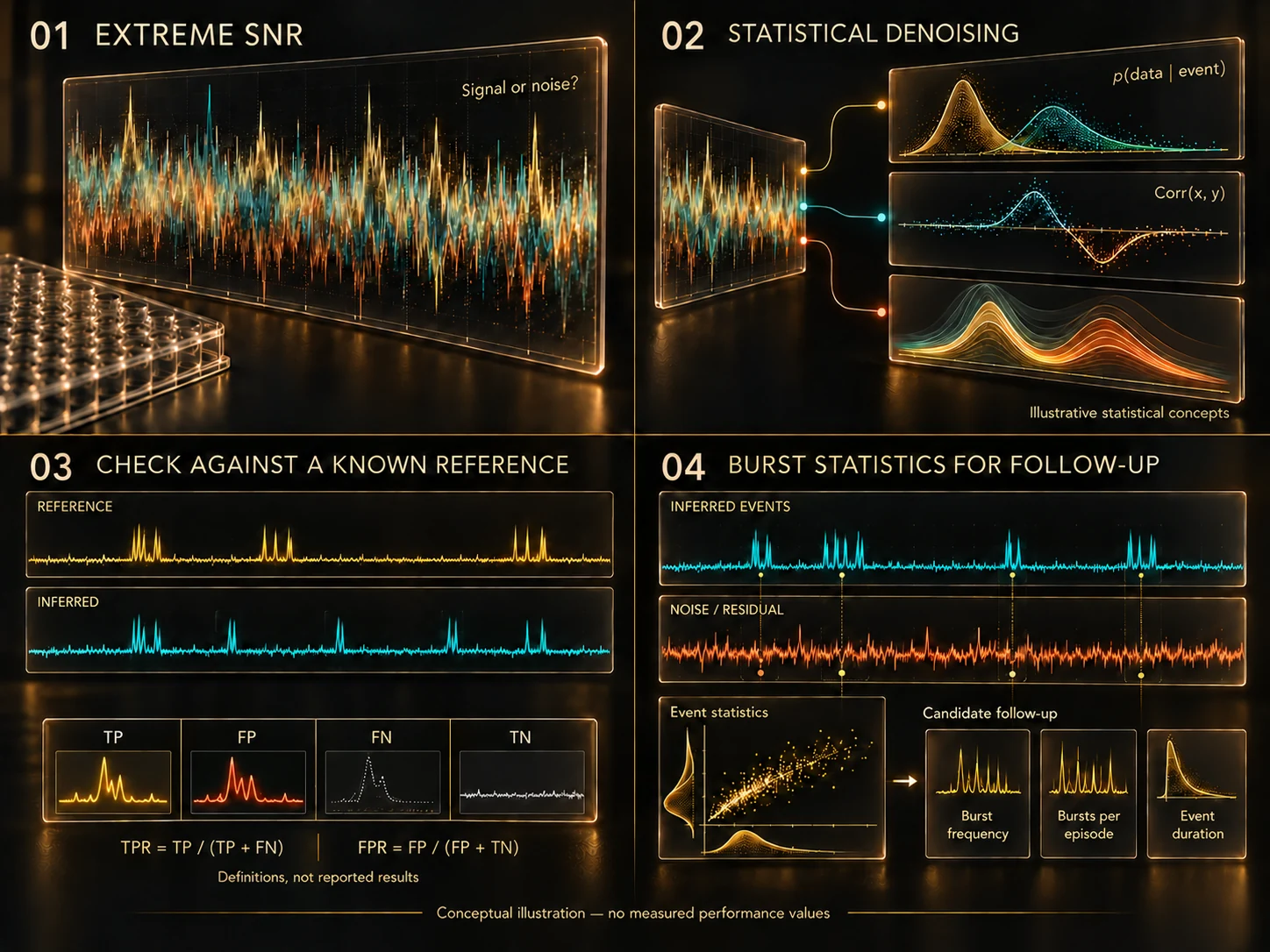
The signal-to-noise ratio describes the strength of a response relative to background variation. At very low SNR, individual events can become difficult to distinguish, and closely spaced responses can merge into an ambiguous pattern. When useful signal and noise have similar properties, filtering can also suppress features that matter to the scientific question.
NORAX brings advanced denoising to these difficult recordings. ADETERA tailors the analysis around the measured data, the available information about noise and the response characteristics the study needs to examine. The aim is to investigate whether useful structure can be recovered and how it supports interpretation.
In screening, this is a question about both missed activity and false detections. A false negative can leave a genuine response unrecognized; a false positive can send follow-up work toward a noise-driven event. The recovered features therefore need to be considered alongside controls, reference results and experimental context.
Decision value: a clearer basis for selecting unresolved responses that merit confirmation, with supporting evidence ready for review.

02 | LEGACY DATA & SCREENING REANALYSIS
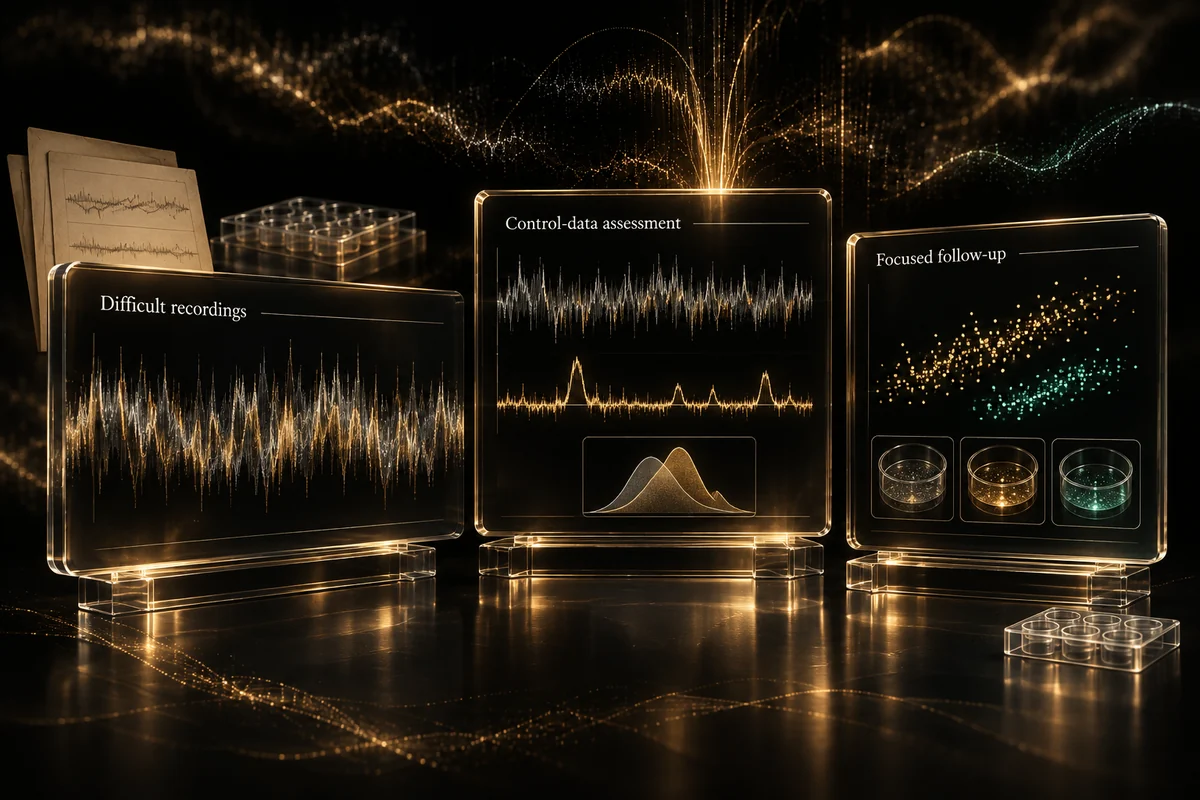
Archived recordings represent laboratory effort, samples and scientific questions that may still matter. Some datasets remain unresolved because the response was weak, event boundaries were unclear or the available processing did not provide a dependable basis for comparison. A new analytical question can make those recordings worth revisiting.
A NORAX engagement can begin with representative legacy data and a specific decision: which apparent nonresponses deserve closer review, which candidate events can be assessed more consistently, or whether a focused repeat experiment would resolve the remaining uncertainty. Available assay conditions, controls and reference recordings provide the context for that assessment.
For plate-based studies, PlateX can connect plate mapping, data collection and broader assay analytics, while NORAX focuses on the difficult signal-recovery question. The scope is tailored to the records and evidence the team actually has.
Decision value: an evidence-based reanalysis of existing recordings and a focused follow-up plan that connects candidate responses with the evidence needed for confirmation.
03 | EVENT SEPARATION & BURST STATISTICS
In one anonymized ADETERA study, evidence from other sources suggested ion-channel activity, but extremely noisy recordings could not reliably resolve individual events and burst patterns. Conventional filtering distorted useful signal structure, leaving the team without dependable statistics for the comparison it needed to make.
ADETERA first assessed its proprietary denoising approach on a group with known results. The workflow was then applied to the unresolved client recordings to support event separation and burst-related statistics. Those results helped guide drug-candidate priorities.
The case illustrates a NORAX application: investigating difficult measurements so they can contribute to a research decision. The known-result assessment provided a reference for the analysis, while the client recordings and experimental context guided interpretation of individual events.
Decision value: usable event and burst evidence to focus candidate follow-up, interpreted alongside the recordings and supporting data.
Read the ion-channel burst caseEVIDENCE & ASSESSMENT
Bring us control recordings or datasets with known results and the response your team needs to assess. ADETERA can evaluate NORAX on those data, comparing recovered events and response patterns with the reference evidence before shaping the workflow around your experimental recordings.
Together, we can examine false detections, missed events and the features that matter to your study, then assess suitability for the intended analysis. This gives your team a practical basis for choosing the workflow, reviewing results and planning focused confirmation experiments.
WORKING WITH ADETERA
Start with the recordings, the scientific question and how the result will be used. ADETERA can tailor NORAX as a standalone analytical system, an optimized workflow, or an automated and integrated capability within an existing research process.
NORAX is built on proprietary ADETERA mathematical models, analytical methods and know-how. Formulations and implementation details are not disclosed here. The engagement defines the analytical scope, the evidence available for assessment and the outputs needed for the development decision.
COMMON QUESTIONS
Representative raw recordings, the response of interest and the experimental conditions are useful starting points. Available controls, noise recordings or known-result data can strengthen the assessment. The available reference evidence helps define the evaluation and identify useful confirmation measurements.
Yes. Existing recordings can be reviewed for a defined scientific question, including weak or ambiguous responses that may warrant renewed investigation. The value of reanalysis depends on the recorded information and its experimental context; a newly identified pattern still needs appropriate assessment before it is treated as a confirmed hit.
PlateX addresses plate mapping, data collection, assay analytics and workflow automation. NORAX specializes in advanced denoising and difficult signal-recovery questions, including extremely low-SNR recordings. ADETERA can connect these capabilities when a plate-based workflow needs more focused investigation of its signals.
START A SCIENTIFIC CONVERSATION
Tell us about your signal-recovery challenge, available reference data and the research decision your team needs to make.