

CARDIX | ANONYMIZED CASE STUDY
Investigate a co-medication concern with a focused model comparison.
Turn an unexpected development concern into specific combination scenarios and scientific questions that can guide the next investigation.
THE SCIENTIFIC QUESTION
A client-reported concern during first-in-human development prompted a retrospective CardiX assessment. Although the earlier hERG and assay picture had raised little concern, the modeled combination amplified repolarization and proarrhythmic features, producing a focused hypothesis for further investigation.
- The challenge
- A reported concern beyond the earlier assay picture
- The intervention
- Retrospective comparison of individual and combined scenarios
- The outcome
- Mechanistic hypotheses and priorities for further investigation
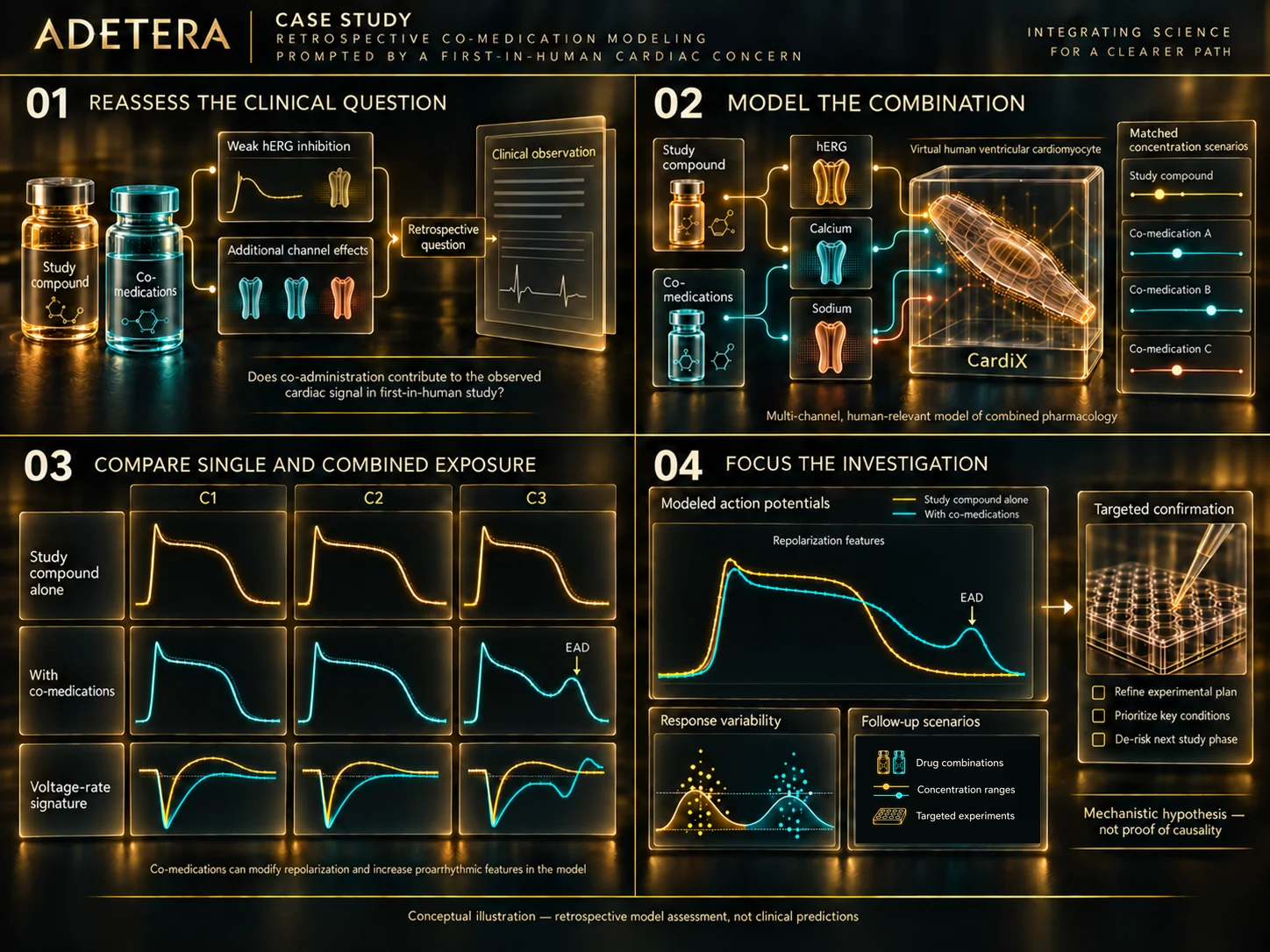
01 / REVISIT THE AVAILABLE EVIDENCE
Define the concern that the earlier assay picture left open.
The client reported an unexpected concern during first-in-human development. Earlier assay findings had not raised the same warning, and the available hERG result indicated weak activity under its tested conditions.
The investigation therefore returned to the compound’s pharmacology in the context of co-medication. The key question was how the cellular response might change when the effects of compounds present together were considered in the same model.
02 / SET UP THE COMBINATION SCENARIOS
Compare each compound with the combined intervention.
CardiX used the available channel information and selected concentrations to construct individual-drug and co-medication scenarios. This created a common cellular framework for comparing the effects separately and together.
The analysis focused on pharmacodynamic interaction: the combined influence of drug effects on cellular electrophysiology. Keeping the concentration assumptions explicit allowed the team to interpret each modeled response in the context of its scenario.
03 / EXAMINE THE MODELED FINDING
Identify the stronger repolarization concern in combination.
The combined scenario amplified the modeled repolarization concern and showed more pronounced proarrhythmic features relative to the individual-drug views. This finding gave the team a specific combination effect to investigate.
It offered a mechanistic hypothesis for how a concern could emerge in a co-medication setting despite the earlier single-compound assay picture. The value of the comparison was in connecting the reported observation with a cellular question that could be examined further.
04 / FOCUS THE FOLLOW-UP
Build the next investigation around a testable hypothesis.
The retrospective assessment organized the combinations, concentration assumptions and cellular features most relevant to follow-up. The client could use this structure to discuss which additional measurements would best test the modeled explanation.
The study moved the investigation from a broad concern toward a focused evidence plan: examine the combination response, check the exposure assumptions and compare the resulting cellular behavior with the proposed mechanism.
WHAT THIS ENABLED
A testable explanation to investigate further.
The modeled combination amplified the repolarization concern, giving the client a mechanistic hypothesis and a more focused plan for investigating the reported development issue.
CardiX uses proprietary ADETERA mathematical models and scientific methods. Detailed formulations and implementation methods are not disclosed.
INTERPRETING THIS CASE
The clinical observation was reported by the client. The model supports a hypothesis, not proof of clinical causation; it does not establish a pharmacokinetic interaction or predict individual patient outcomes.