

CARDIX | ANONYMIZED CASE STUDY
Understand the difference a multichannel view can make.
Help a development team examine whether a hERG-only interpretation changes when the available calcium and sodium channel effects are considered together.
THE SCIENTIFIC QUESTION
Measured calcium and sodium channel concentration-response data expanded the initial hERG-only assessment. In this case, the combined-channel scenario shifted the pattern and onset of modeled repolarization changes, giving the client a more informative basis for follow-up.
- The challenge
- A single-channel view of a multichannel question
- The intervention
- Compare hERG-only and combined-channel scenarios
- The outcome
- A clearer basis for targeted electrophysiology follow-up
01 / ESTABLISH THE SINGLE-CHANNEL VIEW
Start with the hERG-based cellular response.
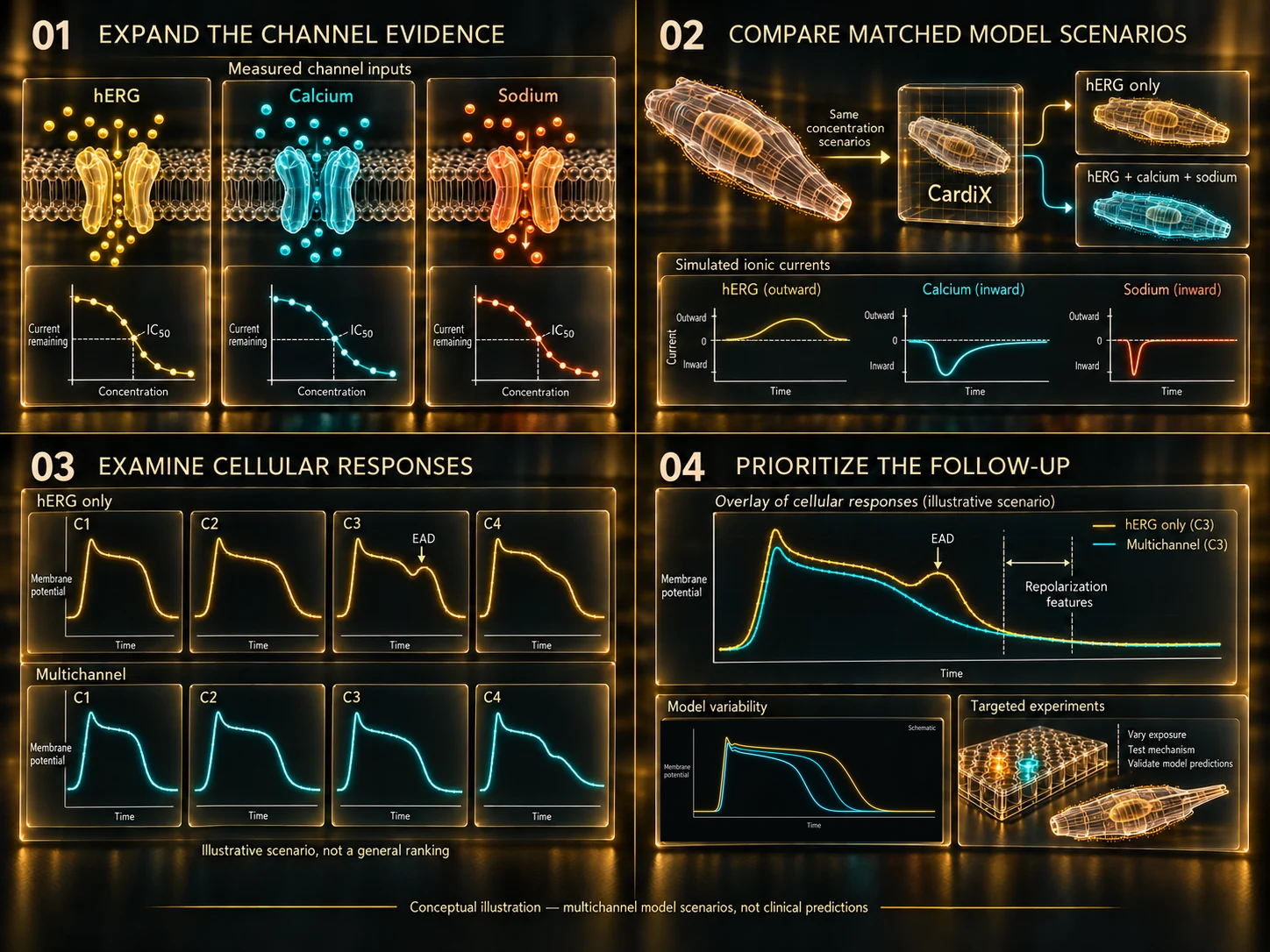
The initial CardiX assessment represented the compound through its hERG effect across selected concentrations. It provided a starting view of how the modeled action potential changed as the drug effect increased.
In this scenario, early afterdepolarizations appeared at a lower modeled concentration than the changes seen in the later combined-channel assessment. These secondary depolarizations during repolarization made the shape and stability of the waveform central to the next question.
02 / ADD THE MEASURED CHANNEL CONTEXT
Bring calcium and sodium evidence into the comparison.
Concentration-response measurements for calcium and sodium channel effects were then available alongside the hERG evidence. CardiX brought these measured inputs into the same cellular-model context for a combined-channel assessment.
The additional pharmacology mattered because the action potential emerges from interacting membrane currents. Calcium and sodium channel effects can change the waveform in which hERG inhibition is expressed, making the full response a question for integrated comparison.
03 / COMPARE THE CONCENTRATION PATTERNS
See how the combined scenario changes the interpretation.
The combined-channel scenario showed less pronounced waveform changes, appearing only at a higher modeled concentration within the assessed range. Its pattern differed from the earlier emergence of EADs in the hERG-only view.
Examining the scenarios side by side connected that shift with the additional measured channel information. The client could compare the onset and character of the modeled repolarization changes rather than relying on one channel result in isolation.
04 / FOCUS THE EVIDENCE PLAN
Turn the model comparison into a sharper experimental question.
The assessment gave the team a specific difference to investigate: why the broader pharmacology changed the modeled response across concentrations. The available channel evidence now informed a clearer cellular question.
This supported planning of targeted electrophysiology follow-up around the concentration range and waveform features of interest. It also showed where additional measurements could help test the interpretation developed from the combined-channel scenario.
WHAT THIS ENABLED
A more complete question for the next cardiac study.
Measured multichannel inputs changed the modeled assessment: the combined scenario showed a later and less pronounced repolarization response than the hERG-only view, focusing the next experimental questions.
CardiX uses proprietary ADETERA mathematical models and scientific methods. Detailed formulations and implementation methods are not disclosed.
INTERPRETING THIS CASE
This was a compound- and scenario-specific model finding. Later or less pronounced cellular changes do not establish universal protection or clinical safety; APD is distinct from ECG QT.