

PLATEX | ANONYMIZED CASE STUDY
Restoring confidence in multi-peak assay analysis.
An intensity-dependent noise correction helped a research team obtain consistent control results and stable calibration responses, making its assay usable for further investigation.
THE SCIENTIFIC FINDING
Nominally matched wells produced different signal intensities. The noise distribution changed with intensity, distorting the statistics extracted from repeated peaks.
- The challenge
- Conflicting statistics after peak separation and alignment
- The intervention
- Characterization and adaptive noise correction
- The outcome
- Consistent controls and stable calibration responses
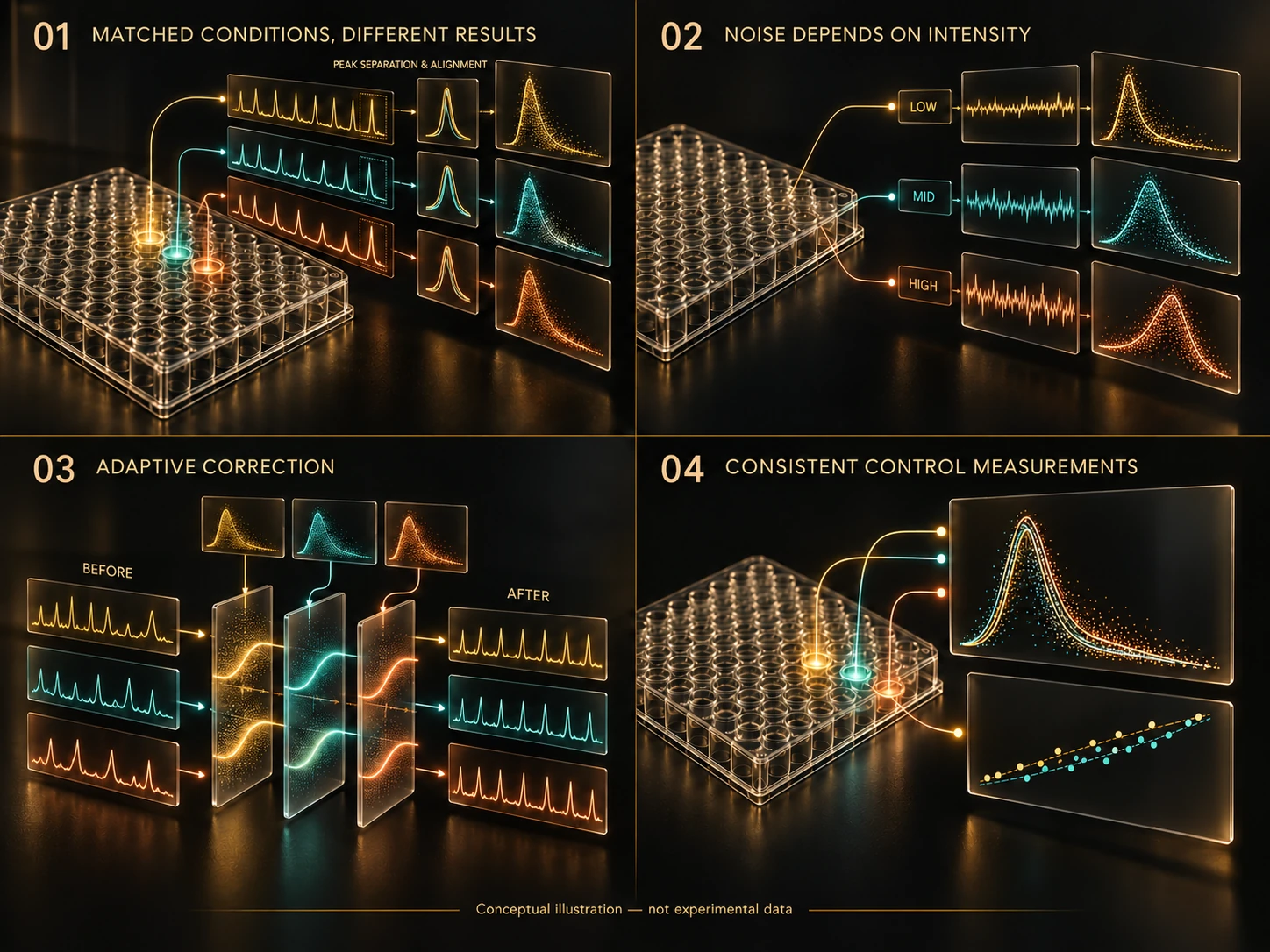
01 / MATCHED CONDITIONS, DIFFERENT RESULTS
Why were comparable wells telling different stories?
A client was using a cell-based assay that recorded repeated sequences of peaks in individual wells. Even when nominal conditions, including concentration, were matched, the distributions obtained after peak detection, separation, alignment and analysis varied unexpectedly.
The inconsistency made the results difficult to interpret. Was the assay itself unreliable, was the equipment contributing to the variation, or was the analysis being affected by a feature of the recorded signal? Resolving that question was necessary before the team could rely on the system for further research.
02 / NOISE DEPENDS ON INTENSITY
The source of variation was hidden in the measurement noise.
This assay-troubleshooting study traced an identified source of well-to-well variability to signal-dependent noise. The noise had a skewed distribution whose shape changed with recorded intensity, so its statistical behavior differed between weaker and stronger recordings.
Modest differences in cell count between wells changed the recorded intensity, despite matched nominal experimental conditions. Because the noise distribution depended on intensity, those differences also changed how noise affected the detected, separated and aligned peaks. This distorted the resulting peak statistics and helped explain why apparently comparable wells produced inconsistent distributions.
03 / ADAPTIVE CORRECTION
Match the correction to the noise actually present.
We characterized how the noise distribution changed with recorded intensity and used that relationship to develop an adaptive correction method. The correction accounted for the intensity-dependent noise behavior affecting peak detection, separation, alignment and the resulting statistics.
The work addressed an identified source of measurement-related distortion. Agreement between wells was then assessed through control and calibration measurements, rather than assumed from the appearance of a cleaner trace. The mathematical models and implementation details remain proprietary to ADETERA.
04 / CONSISTENT CONTROL MEASUREMENTS
A dependable basis for the next experiments.
After correction, repeated control observations became consistent, and calibration responses were stable. The client could use the system for further research with the identified source of analytical inconsistency addressed.
For the research team, the practical outcome was a usable measurement and analysis workflow. For the scientific team, it was a clearer understanding of how cell-count variation, signal intensity and noise behavior had combined to affect the original results.
WHAT THIS ENABLED
A usable system for the next stage of research.
The identified source of analytical inconsistency was addressed, giving the team a more dependable basis for interpreting subsequent measurements and continuing its investigations.