
PLATEX | ANONYMIZED CASE STUDY
Making legacy plate data usable again.
A tailored PlateX workflow turned a fragmented archive of cell-based multiwell recordings into organized analytical results, enabling a research team to compare its historical studies.
THE SCIENTIFIC QUESTION
Plate coordinates and well contents changed between studies, while repeated events were affected by heterogeneous noise. Meaningful comparison required reconnecting signals with their experimental context before applying the client’s analytical specifications.
- The challenge
- Varied plate layouts and noisy legacy recordings
- The intervention
- Dynamic mapping, adaptive denoising and event detection
- The outcome
- Historical studies organized for comparison
01 / A FRAGMENTED RESEARCH ARCHIVE
An archive without a shared analytical view.
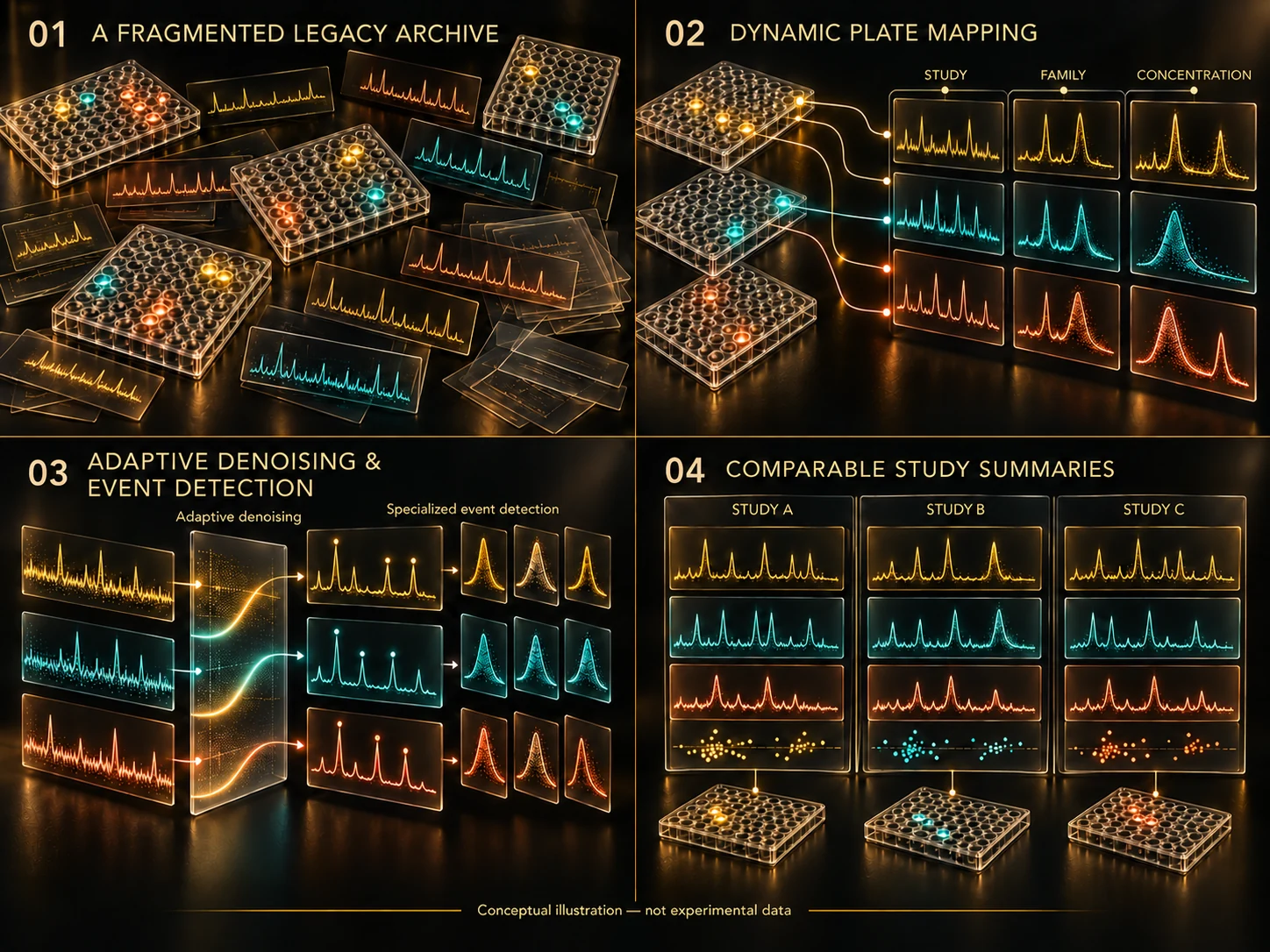
A research team held a large archive of cell-based multiwell recordings. Each well could contain many events with heterogeneous noise. Peak assessment relied largely on manual visual inspection.
Layouts varied between studies, and historical results had never been consolidated. Comparing studies required more than applying one analysis to a fixed plate layout.
02 / DYNAMIC PLATE MAPPING
Let the grid follow the experiment.
ADETERA reviewed the existing data and developed a dynamic mapping grid to represent the layouts used in different studies. Signals were reorganized by study section, family and concentration using the available experimental records.
For this retrospective data analysis, plate-map harmonization connected well positions with experimental metadata, creating a consistent basis for comparing the client’s historical studies.
03 / FROM SIGNALS TO EVENTS
Adaptive Denoising & Event Detection
Adaptive denoising addressed the heterogeneous noise in the recordings. Specialized event detection was tailored to the varied signals so that detected events could be analyzed in their experimental context. Statistics were produced according to the client’s specified requirements.
Scientific comparisons stayed connected to the mapped studies, while the client’s detailed statistical specifications and ADETERA’s analytical methods remained confidential.
04 / CROSS-STUDY CONSOLIDATION
Compare the historical work in context.
The resulting workflow brought study layouts, processed recordings and analytical outputs into a common structure. The client could compare historical studies through the relevant sections, families and concentrations.
For the research team, the practical outcome was a consolidated view of work that had previously depended on separate, largely manual inspections. Existing recordings could now contribute to cross-study questions.
WHAT THIS ENABLED
A historical archive that the team could compare.
The value came from connecting existing recordings, experimental context and client-defined analysis in one usable workflow.