

PLATEX | ANONYMIZED CASE STUDY
Separating main pulses from hidden after-pulses.
Give development teams separate evidence for main pulses and after-pulses across drug concentrations, even when the recorded events overlap.
THE SCIENTIFIC QUESTION
In this client cell-based assay, larger main pulses were accompanied by smaller after-pulses. Noise and overlapping responses made it difficult to examine the two event populations independently. PlateX combined adaptive denoising, proprietary model-informed reconstruction and aligned event analysis to produce separate waveform collections and statistics for the client's concentration-dependent assessment.
- The challenge
- Overlapping main pulses and smaller after-pulses
- The intervention
- Adaptive denoising and model-informed reconstruction
- The outcome
- Separate waveform collections and concentration-dependent statistics
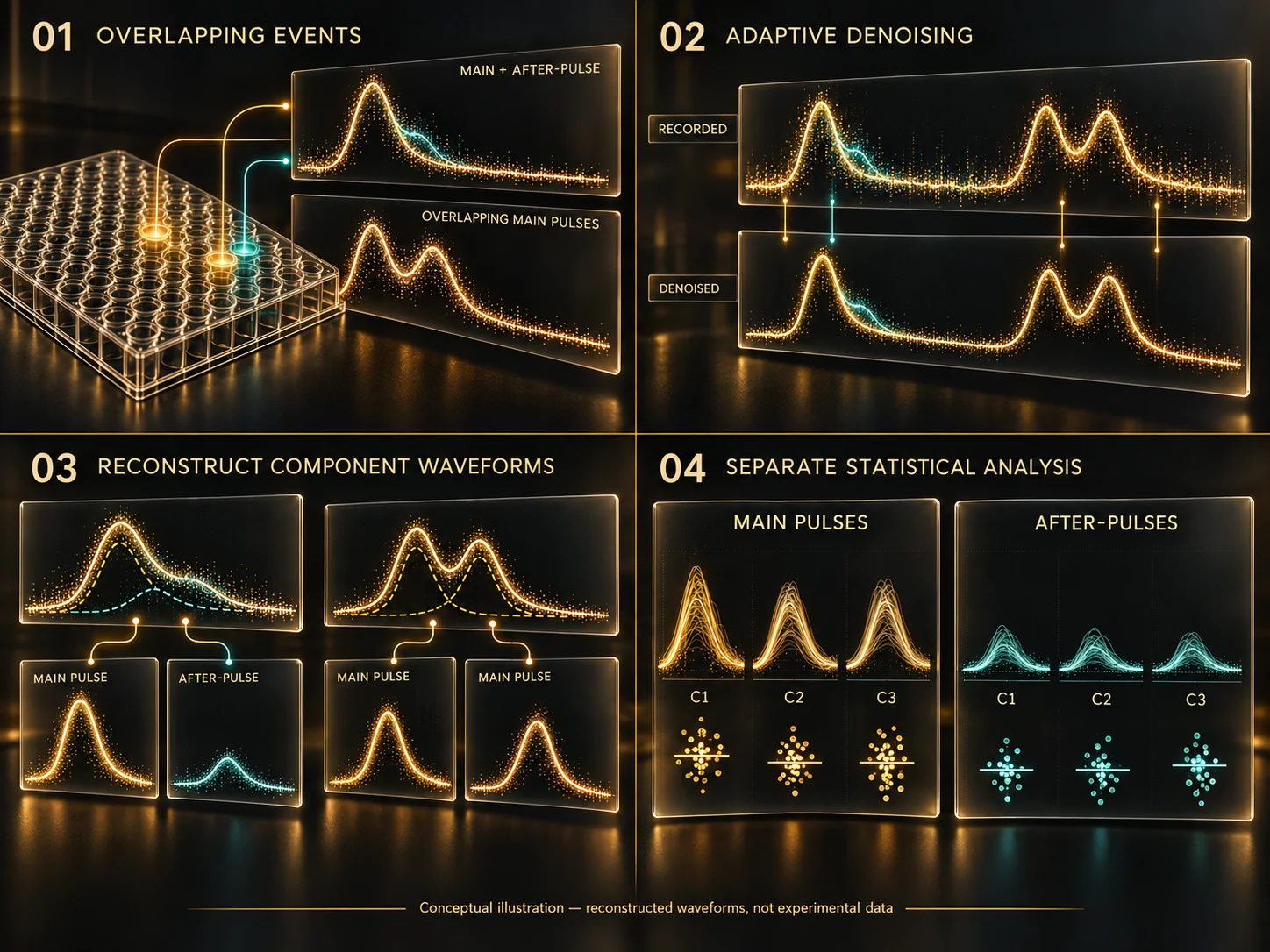
01 / OVERLAPPING EVENTS
When several events appear as one
Some smaller after-pulses overlapped larger main pulses, obscuring their individual shapes. In other parts of the recording, two large pulses overlapped to form a compound or double peak. These patterns created different analytical problems within the same dataset: a visible feature could contain contributions from more than one event. Together with background noise, this prevented straightforward collection and statistical comparison of the main pulses and after-pulses separately.
02 / ADAPTIVE DENOISING
Reduce noise before resolving overlap
Adaptive denoising addressed the noise contribution to the recorded traces. This provided a clearer basis for examining event structure, while leaving the overlap problem to a separate analytical stage. A cleaner compound peak still contains potentially overlapping contributions; smoothing its appearance alone does not establish the shape of each underlying event. The workflow therefore treated noise reduction and event separation as connected but distinct tasks.
03 / COMPONENT RECONSTRUCTION
Reconstruct the component waveforms
This pulse-separation step used model-informed waveform decomposition to estimate the overlapping main-pulse and after-pulse components. Proprietary ADETERA models guided their reconstruction. The analysis addressed smaller events overlapping larger responses, as well as overlapping main pulses that produced compound peaks. The reconstructed components were organized into separate, aligned event collections. This made the two populations available for independent examination while preserving their connection to the source recordings and the relevant experimental conditions.
04 / CONCENTRATION-DEPENDENT ANALYSIS
Compare each event population across concentrations
With the event collections separated and aligned, the client could examine main-pulse and after-pulse shapes independently across drug concentrations. Advanced statistical analyses followed the client's confidential specifications, rather than applying one combined analysis to the composite traces.
WHAT THIS ENABLED
Separate evidence for the next assay decision.
The resulting deliverable gave the client separate waveform information and statistics for both event populations across the concentration series—a clearer basis for evaluating the assay responses and deciding what to investigate next.